- AI is making financial content easier to create, but harder to differentiate.
- Visibility alone matters less as content volume increases.
- Prospects are increasingly evaluating tone, judgment, and trustworthiness, not just expertise.
- Education-led marketing creates human signals AI-generated content cannot easily replicate.
- Advisors who teach clearly and consistently will gain advantage as generic content expands.
The More AI Content There Is, the More Trust Becomes the Differentiator
As financial content becomes easier to generate, advisors who build trust through perspective, education, and consistency will stand out faster.

Nick Schilling
CEO
Most advisors can already feel the shift happening across marketing. Content that once took days to create can now be produced in minutes. AI tools can generate blog posts, emails, social captions, webinar outlines, and even entire campaigns almost instantly.
At first glance, this feels like an advantage. More content should create more visibility. More visibility should create more opportunity.
But a different problem is quietly emerging beneath the surface.
As AI-generated content floods inboxes, search results, LinkedIn feeds, and advisor websites, information itself becomes less valuable as a differentiator. Prospects are no longer struggling to find financial content. They are struggling to decide who actually understands what matters to them, who can explain decisions clearly, and who feels trustworthy enough to guide them through uncertainty.
That shift changes the role of marketing.
The advisors who stand out over the next several years will not necessarily be the ones producing the most content. They will be the ones using content to create trust, clarity, and confidence before the first meeting ever happens.
As information becomes infinite, trust becomes scarce.
Key Takeaways
AI Is Flooding the Market with Content, Not Trust
The barrier to creating financial marketing content has collapsed.
A few years ago, producing a steady stream of advisor content required significant time, coordination, and effort. Firms needed writers, designers, strategists, editors, and subject matter experts to consistently publish articles, guides, emails, webinars, and campaigns.
Today, much of that production process can happen in a single afternoon.
AI tools can generate outlines, summarize research, draft articles, create social captions, suggest headlines, and repurpose webinars into dozens of smaller content assets within minutes. That efficiency is real, and for many firms, it is genuinely useful.
The challenge is not the technology itself. The challenge is what happens when everyone gains access to the same efficiency at the same time.
As more firms rely on AI-generated marketing, financial content begins sounding increasingly similar. The structure becomes familiar. The tone becomes predictable. Articles repeat the same themes, the same phrasing, and the same surface-level explanations because many are drawing from the same pools of publicly available information.
The result is not necessarily bad content. It is interchangeable content.
Prospects begin encountering endless variations of the same retirement tips, tax strategies, market commentary, and planning checklists across multiple platforms. Over time, volume creates fatigue. People stop evaluating content based on whether it exists and start evaluating whether it feels credible, useful, and human.
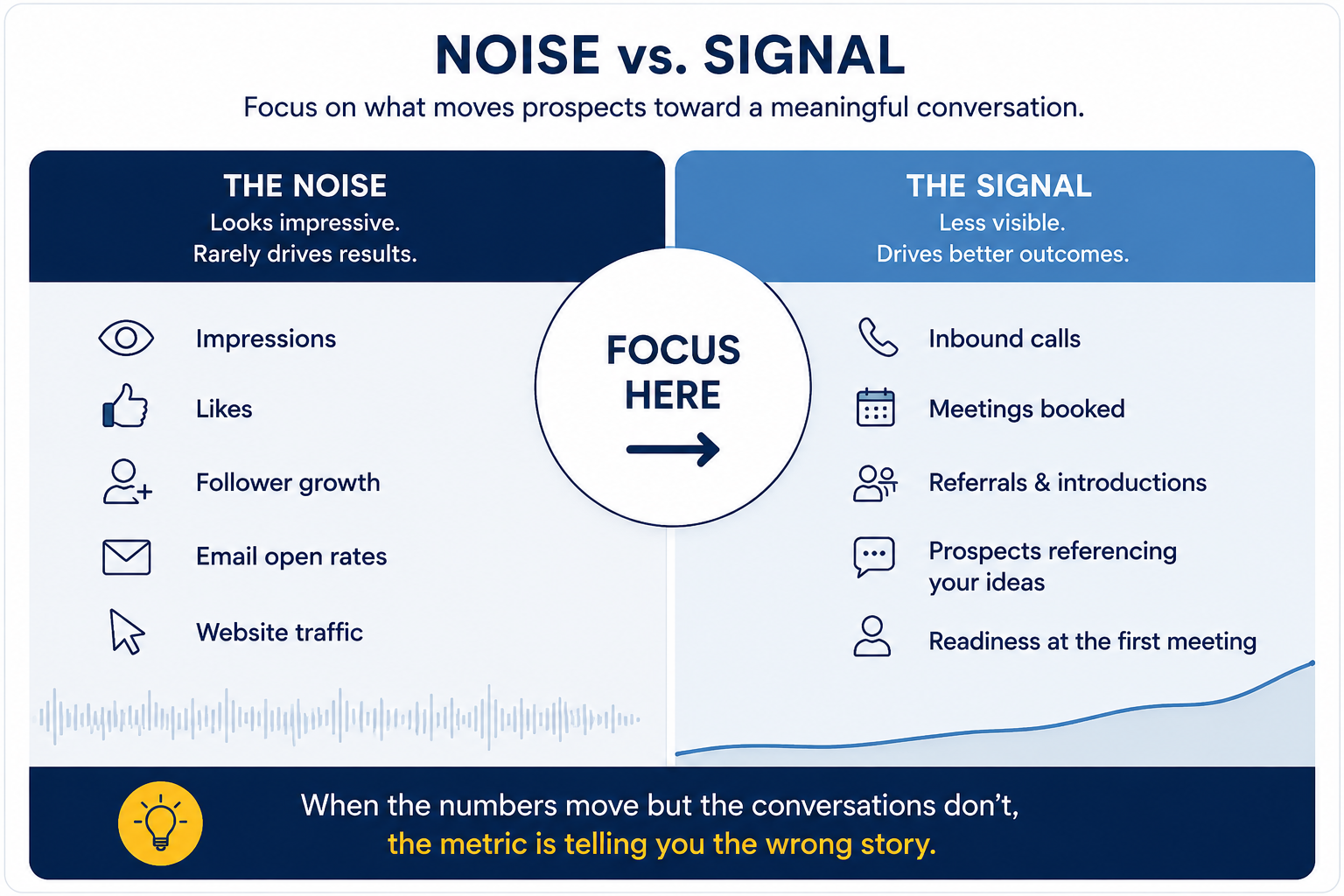
This is one reason visibility alone is becoming a weaker differentiator. Simply publishing more frequently no longer guarantees stronger positioning because prospects are already overwhelmed by information.
That dynamic closely reflects themes explored in The Smart Marketer’s Blueprint, which emphasizes that advisors often waste time chasing visibility metrics instead of building systems that support trust and long-term engagement.
Prospects Are Not Looking for More Information. They’re Looking for Signals.
Most households already have access to more financial information than they can realistically process.
They can search retirement questions online at any hour of the day. They can watch market commentary on YouTube, compare investment strategies through podcasts, or ask AI tools to explain financial concepts instantly. Information is no longer scarce.
What remains scarce is confidence.
Prospects are still trying to answer deeper questions that information alone does not fully resolve:
-
Who actually understands what I’m worried about?
-
Who explains things clearly without oversimplifying them?
-
Who sounds grounded during uncertainty?
-
Who feels trustworthy enough to guide us through important decisions?
These are trust questions, not information questions.
That distinction matters because trust signals operate differently than content volume. Prospects are paying attention to tone, consistency, judgment, and whether an advisor’s communication feels calm and thoughtful when situations become emotionally complicated.
This is why many firms can produce large amounts of content while still struggling to generate meaningful conversations. Visibility does not automatically create trust. In some cases, too much generic content can actually weaken differentiation because prospects stop seeing meaningful differences between firms.
The advisors who build stronger momentum are often the ones helping people think clearly rather than simply publishing more often.
That behavior aligns closely with patterns explored in Why Most Advisor Marketing Fails, which explains how prospects move through a long private research phase before they ever engage directly with an advisor. During that process, people are not just gathering information. They are evaluating who feels credible enough to trust.
Prospects rarely remember who posted the most. They remember who helped them think clearly.
AI Can Replicate Information Faster Than It Can Replicate Judgment
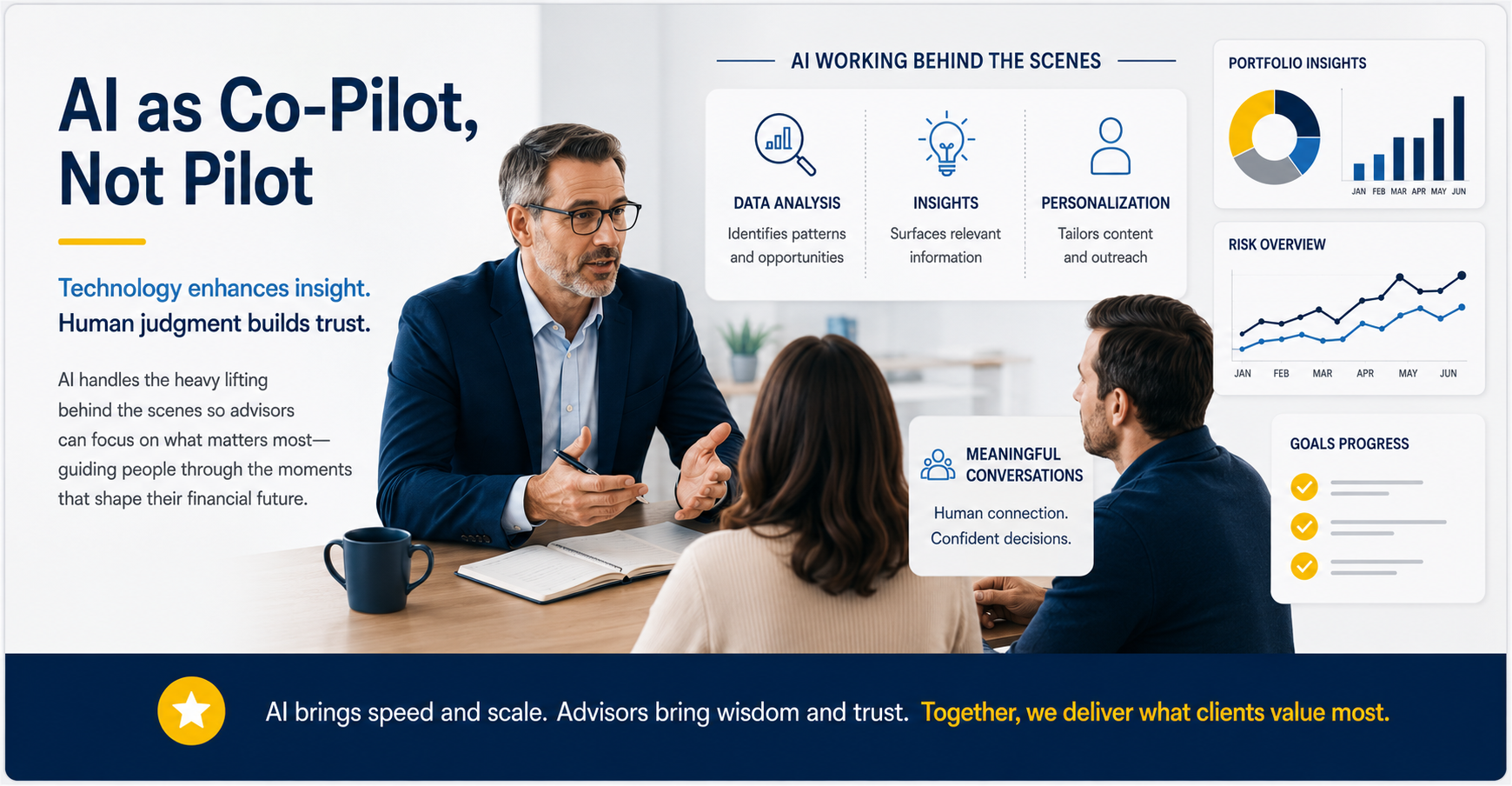
AI is exceptionally good at organizing and generating information.
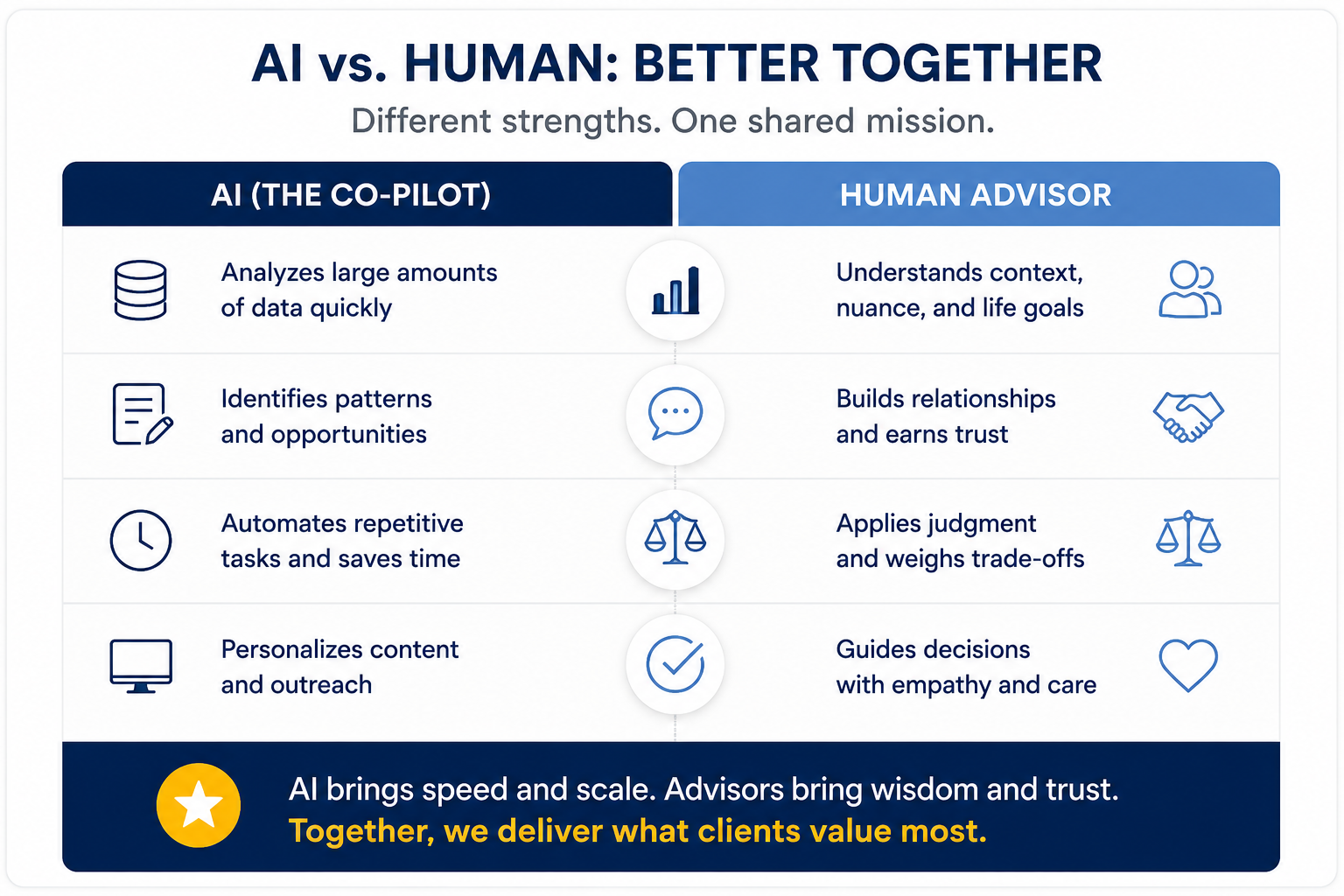
It can summarize articles, identify patterns, produce drafts, and explain broad financial concepts at remarkable speed. For advisors, that creates meaningful opportunities to streamline content production and reduce repetitive marketing work.
What AI struggles to replicate is judgment.
Financial decisions are rarely just informational. They are emotional, contextual, and deeply personal. Prospects are not only evaluating whether an advisor understands retirement planning, taxes, or investment strategy. They are evaluating how that advisor thinks when situations become uncertain or emotionally charged.
That evaluation happens through subtle signals:
-
How does this advisor explain tradeoffs?
-
Do they sound reactive or grounded?
-
Do they acknowledge complexity honestly?
-
Can they simplify difficult concepts without sounding scripted?
-
Do they communicate with restraint or urgency?
Those signals are difficult to automate because they emerge from lived experience, perspective, and human interaction rather than information assembly alone.
This does not mean advisors should avoid AI. In many ways, the opposite is true.
The firms that use AI effectively will likely gain significant efficiency advantages. AI can support drafting, repurposing, segmentation, summarization, and operational consistency. It can help advisors scale communication more efficiently and free up time for higher-value work.
But AI works best as an assistant, not a replacement for human trust formation. That principle aligns closely with guidance outlined in The Smart Marketer’s Blueprint, which encourages advisors to use AI strategically while keeping messaging, judgment, and relationship-building fundamentally human.
Why Education Becomes More Valuable in an AI-Heavy World
As AI-generated content expands, education becomes more valuable because it creates interaction, not just information delivery.
That difference is important.
Most content is passive. Someone scrolls through a post, skims an article, or watches part of a video before moving on to the next piece of information competing for their attention.
Education works differently because it creates an experience.
When advisors teach through workshops, webinars, guides, or structured educational events, prospects begin evaluating more than expertise alone. They experience how the advisor explains decisions, frames tradeoffs, responds to questions, and guides people through uncertainty.
That interaction creates trust signals AI-generated content cannot easily replicate.
Prospects begin forming impressions such as:
-
This person explains things clearly.
-
This feels thoughtful rather than performative.
-
I understand how they approach decisions.
-
I can picture working with this advisor.
The emotional tone changes because education lowers pressure. Instead of pushing prospects toward immediate action, it gives them space to learn and evaluate fit at their own pace.
This dynamic aligns directly with ideas explored in Trusted from the Start, which positions education as a trust accelerator that allows prospects to experience an advisor’s reasoning before the first one-on-one meeting ever takes place.
It also reflects themes from How Education Filters the Right Clients, which explains how teaching reveals standards, expectations, and decision-making philosophy long before formal onboarding begins.
The Advisors Who Win Will Feel More Human, Not More Automated
AI will continue changing how financial marketing gets produced. That shift is already underway, and firms that ignore it entirely will likely fall behind operationally.
But the advisors who stand out over the next decade will probably not be the ones who automate everything possible. They will be the ones who become more intentionally human while using technology strategically behind the scenes.
That means sounding calmer, clearer, and more grounded while much of the internet becomes louder and more automated.
It means simplifying complexity without oversimplifying reality.
It means teaching consistently instead of reacting emotionally to every headline.
It means helping prospects feel more confident and more oriented during uncertain periods.
Ironically, the rise of AI may increase the value of the very qualities many advisors already possess naturally: judgment, patience, perspective, empathy, and the ability to guide people through emotionally complicated decisions.
People may increasingly expect efficiency from software, but they will still look to humans for reassurance, interpretation, and confidence when stakes feel personal.
That distinction matters because trust is rarely built through information alone. It forms through repeated experiences that make prospects feel understood, informed, and supported before major decisions happen.
The future advantage will not belong to the firms producing the highest volume of content.
It will belong to the firms creating the strongest trust-building experiences.
The future of advisor marketing is not less human. It’s more intentionally human.
Conclusion
The rise of AI-generated content will not eliminate the need for financial advisors. In many ways, it may increase the value of advisors who communicate with clarity, perspective, and trustworthiness.
As financial information becomes easier to produce, prospects will rely more heavily on signals that feel human: consistency, teaching, judgment, calmness, and the ability to simplify difficult decisions without oversimplifying reality.
That shift favors advisors who build trust before the first meeting.
The firms that stand out over the next decade are unlikely to be the loudest. They will be the ones who help people feel more confident, more informed, and more understood in a world overflowing with information.
Build Trust Before the First Meeting
See how FMT Solutions helps advisors use education-led marketing to create trust-building experiences that stand out in an increasingly automated world.