From Classroom to Client: What Daniel Goldsmith Reveals About Education-Led Growth
Why More Advisors Are Replacing Prospecting with Teaching

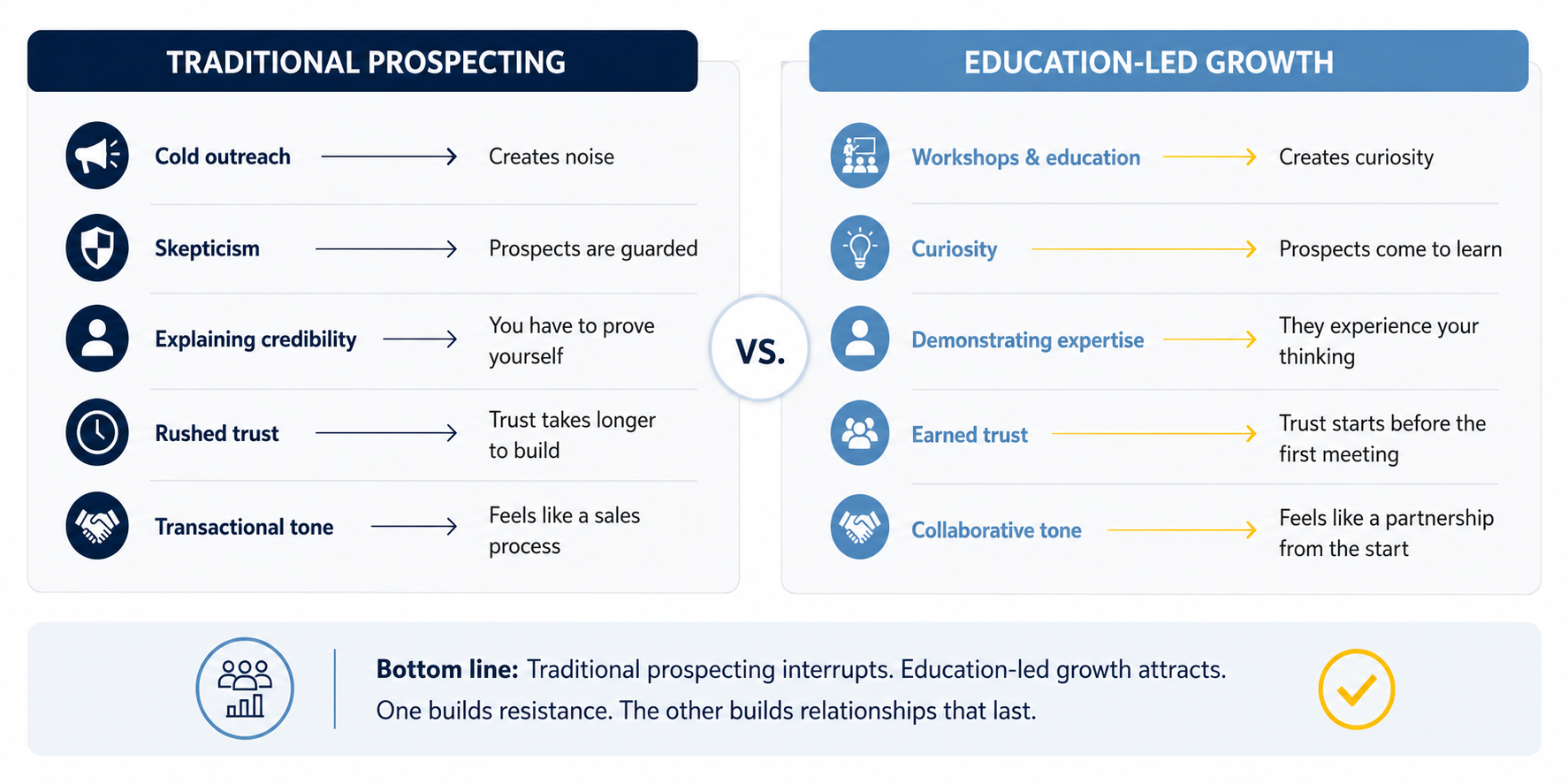
By the time many individuals and families finally agree to a first meeting, they are already carrying skepticism, uncertainty, and decision fatigue. Traditional prospecting often makes that worse. Cold outreach, generic seminars, and repetitive marketing campaigns ask prospects to trust an advisor before they fully understand how that advisor thinks.
That dynamic came up during a recent conversation with Daniel Goldsmith, Managing Partner at Ascend Financial Group.
Ascend is a comprehensive financial planning firm serving clients across Minnesota, Montana, and North Dakota. Over the past several years, the firm has built much of its growth strategy around educational workshops, using classroom-style events to introduce prospects to their planning philosophy before any formal consultation takes place.
During the conversation, Daniel shared how that approach has fundamentally changed the tone of client acquisition for the firm.
Instead of trying to convince prospects to take a meeting, education gives people the opportunity to experience an advisor’s reasoning first.
And according to Daniel, that changes everything.
For a deeper look at how education-led growth performs in practice, read Ascend Financial Group’s case study, where they share how they hosted more than 65 workshops, achieved an 80% appointment rate, and generated approximately $3M in AUM per campaign.
The Shift from Selling to Teaching
One of the strongest themes throughout the discussion was simple:
People respond differently when they feel like they are learning instead of being sold to.
That distinction matters because financial decisions are deeply personal. Prospects are not just evaluating performance claims or credentials. They are trying to determine whether an advisor’s process feels thoughtful, understandable, and aligned with how they want to make decisions.
Education creates space for that evaluation.
Through workshops and classroom-style events, prospects get to hear how an advisor explains tradeoffs, frames uncertainty, and guides decision-making before there is ever pressure to commit.
The relationship begins with understanding rather than persuasion.
That shift often lowers resistance immediately.
As Daniel explained, educational environments tend to create more natural conversations because attendees arrive expecting to learn, not defend themselves against a pitch.

Why Workshops Produce Better-Fit Clients
The conversation also reinforced an important point many advisors quietly recognize:
Not every prospect is the right fit.
Some clients want ongoing guidance, structure, and long-term planning. Others want reassurance without process or constant adjustments without discipline.
Education helps reveal the difference early.
Daniel discussed how workshops naturally attract individuals who are willing to engage thoughtfully with financial decisions. These are often the people who:
- Ask deeper questions
- Stay engaged after events
- Involve spouses or family members
- Follow through on next steps
- Value planning rather than quick answers
That creates a very different type of first meeting.
Instead of starting from zero, advisors often sit down with prospects who already understand the philosophy behind the recommendations being discussed.
The groundwork has already been laid.
Trust Forms Before the First Appointment
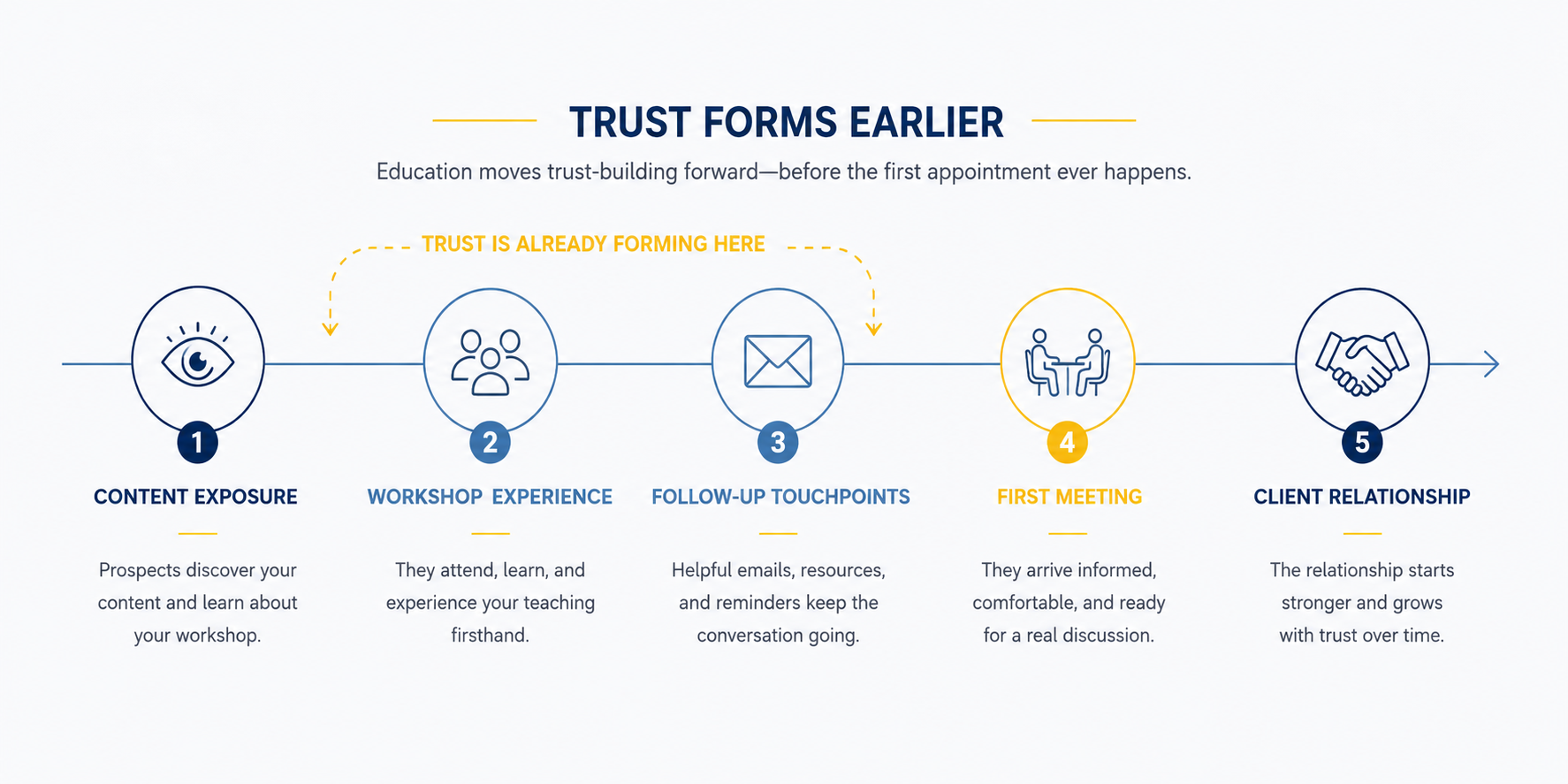
One of the clearest takeaways from the conversation was that education shortens the trust-building cycle.
Traditional marketing often assumes trust develops after multiple meetings. Education changes the order.
When someone attends a workshop, spends several hours learning from an advisor, and continues engaging afterward, they begin forming conclusions long before a formal consultation happens.
By the time they schedule an appointment:
- They already recognize the advisor’s communication style
- They understand key planning concepts
- They have seen how the advisor approaches complexity
- They feel more comfortable asking meaningful questions
That familiarity changes the emotional tone of the relationship.
Instead of “figuring out whether they trust you,” prospects arrive trying to determine how to move forward.

Why Consistency Matters More Than Marketing Noise
Another important theme throughout the conversation was consistency.
Daniel emphasized that sustainable growth rarely comes from chasing trends or constantly reinventing marketing tactics. The firms seeing the strongest long-term results are often the ones building repeatable educational systems that compound over time.
For Ascend, that has meant continuing to invest in workshops year after year rather than treating education as a one-time campaign. Over time, those repeated touchpoints have helped the firm build familiarity and credibility within the communities they serve.
That consistency matters because trust compounds through repeated exposure.
Each workshop, follow-up email, guide, or educational touchpoint reinforces the advisor’s perspective and planning philosophy. Prospects begin connecting the advisor’s name with clarity, structure, and thoughtful guidance.
Over time, that creates momentum that feels very different from traditional prospecting.
Instead of constantly “starting over” with cold audiences, advisors build familiarity inside their communities.
Education Changes the Quality of Conversations
Perhaps the most practical insight from the discussion is that education improves the conversations themselves.
Advisors spend less time:
- Explaining foundational concepts repeatedly
- Overcoming skepticism
- Clarifying misconceptions
- Defending the value of planning
And more time discussing:
- Goals
- Tradeoffs
- Implementation
- Long-term strategy
- Real planning decisions
That shift improves efficiency, alignment, and relationship quality simultaneously.
Education does not simply create more leads.
It creates more prepared conversations.
A Different Way to Think About Growth
The advisors highlighted throughout Return on Education are not necessarily growing because they market more aggressively.
They are growing because education allows prospects to understand their value before the first sales conversation ever begins.
Ascend Financial Group is one example of what that can look like in practice. By consistently teaching first, Daniel and his team have built a process that attracts more informed prospects and creates stronger alignment from the very beginning of the relationship.
That creates:
- Stronger trust
- Better-fit clients
- Higher engagement
- More referrals
- More sustainable growth
And perhaps most importantly, it creates a business development process that feels more aligned with how many advisors actually want to operate.
Less pressure.
More teaching.
More clarity.
Better relationships.
Put Education to Work Before the First Meeting
FMT Solutions helps independent financial advisors build education-led growth systems through the Financial Educators Network (FEN). From compliance-ready courses and classroom support to targeting and follow-up strategies, FMT equips advisors to teach first and build trust earlier.
When prospects experience your thinking before the first appointment, the entire relationship changes.
Ready to see how education-led growth works?
Explore how FMT Solutions helps advisors turn classrooms into long-term client relationships.