What Does Buying an EV Have to Do With Choosing a Financial Advisor?

What researching an EV taught me about how prospects evaluate financial advisors quietly, slowly, and long before they ever schedule a call.

Nick Schilling
Nick Schilling
CEO

A few months ago, our family started researching a new car.

Specifically, an EV.

At first, it felt like a casual idea. Gas prices were fluctuating again. More friends were buying electric vehicles. The technology seemed to be improving quickly, and for the first time, the timing felt worth seriously exploring.

What surprised me wasn’t how many choices existed.

It was how long the decision quietly lived in the background before we ever talked to a salesperson.

For weeks, the process unfolded in fragments.

A YouTube review after dinner.

A Reddit thread before bed.

A comparison article forwarded to my wife.

A reopened browser tab I thought I’d already ruled out.

We watched charging demos. Read reliability reports. Compared range estimates. Looked at financing options. Debated whether the infrastructure was really “ready enough.” At one point, I realized I had watched the same review video twice because I trusted how clearly the person explained tradeoffs.

And through all of it, we never once filled out a lead form.

We weren’t ready.

Not because we lacked interest. Quite the opposite. The decision had become important enough that we wanted to understand it before inviting someone else into the process.

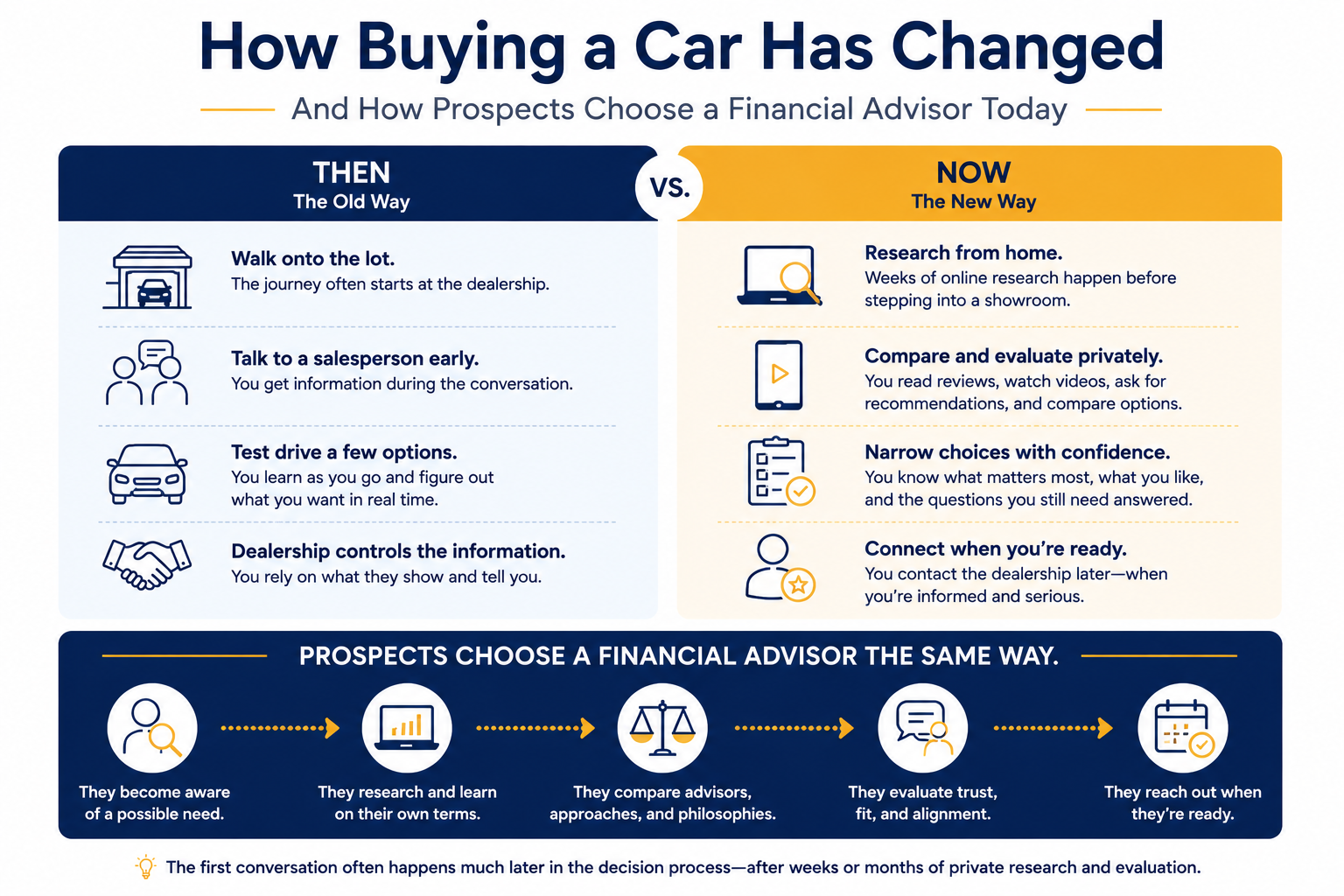
By the time we finally walked into a dealership, the real evaluation had already been happening for weeks.

The salesperson who ultimately won us over wasn’t the most aggressive or polished. He was the most useful.

He answered questions clearly. He helped us think through tradeoffs we hadn’t considered. He added to our research instead of interrupting it. At some point during the conversation, he stopped feeling like a salesperson and started feeling like a guide.

Afterward, I realized how differently people make important decisions now.

And I realized how closely that behavior mirrors what prospects are doing when they search for a financial advisor.

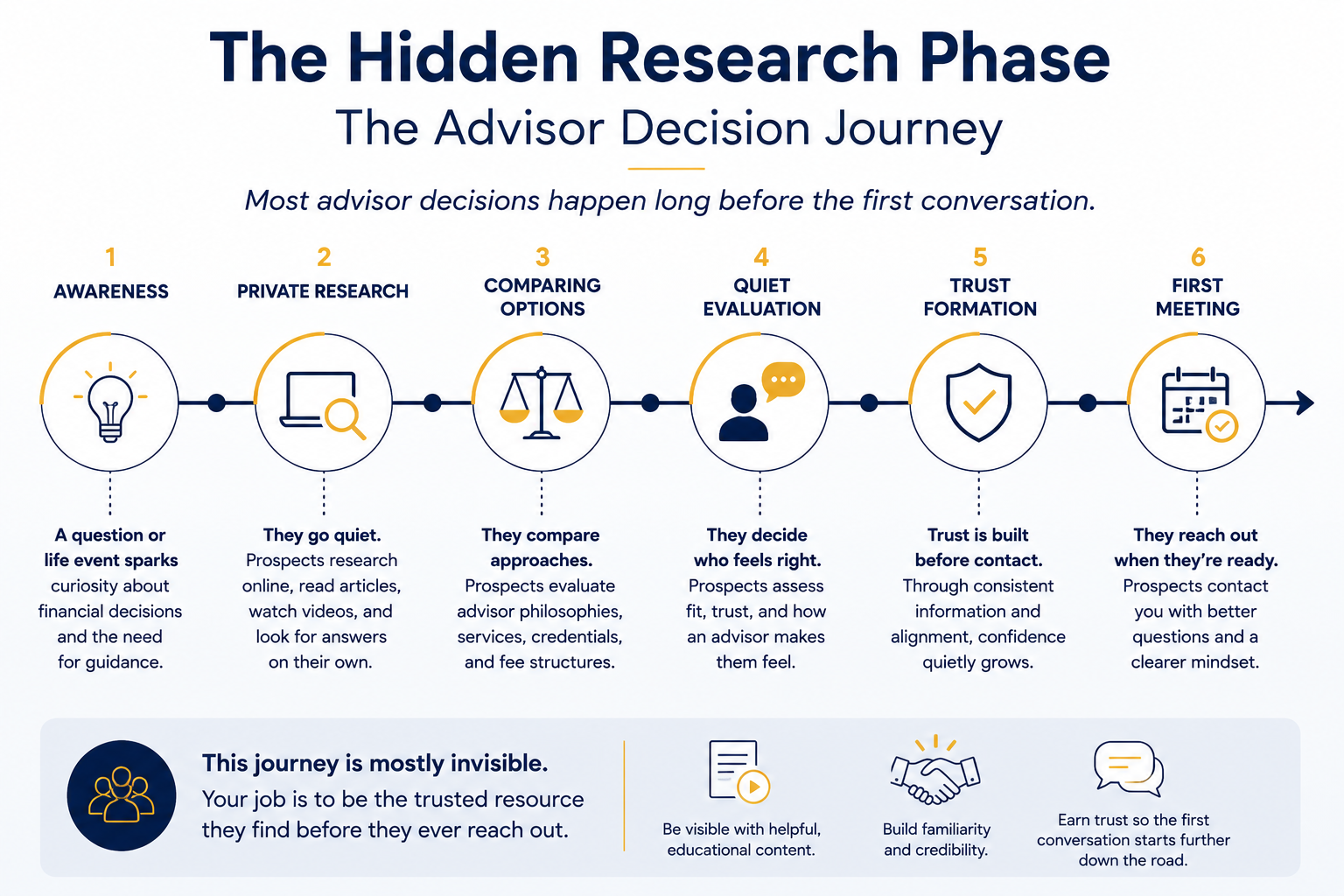
Many prospects are not ignoring advisors. They are researching privately long before they ever reach out.

Most advisors still think of the first meeting as the beginning of the decision process.

Increasingly, it’s closer to the end.

Before scheduling a call, prospects are already doing quiet evaluation work:

  • Reading articles
  • Comparing philosophies
  • Revisiting financial concerns with spouses
  • Consuming educational content
  • Searching for signals that feel trustworthy
  • Deciding which advisors feel calming versus performative

Much of this happens invisibly.

No form fills.

No booked meetings.

No obvious buying signals.

From the advisor’s perspective, it can look like hesitation or disinterest.

But often, something much more important is happening:  the prospect is trying to reduce uncertainty before taking the next step.

That distinction matters because it changes how marketing actually works.

Many firms still design outreach around immediate response. The assumption is that if someone does not engage quickly, the opportunity is fading.

But modern decision-making rarely works in a straight line anymore, especially for high-trust services.

People pause.

Revisit.

Compare.

Discuss.

Wait.

Reopen tabs.

Come back weeks later.

Sometimes the most interested prospect is also the quietest one.

By the time prospects schedule a meeting, many have already spent weeks quietly deciding who feels trustworthy.

The firms winning right now seem to understand this intuitively.

They are not trying to force faster decisions. They are supporting the research phase itself.

They stay visible without becoming overwhelming.

They teach instead of constantly pitching.

They create useful content designed to reduce confusion rather than manufacture urgency.

Most importantly, they help prospects feel more informed before the first meeting ever happens.

That changes the emotional tone of the relationship early.

When someone has repeatedly learned from you before contacting you, the first conversation feels different. There is less suspicion. Less orientation. Less need to “sell” credibility from scratch.

The prospect already has context for how you think.

That’s what the best salesperson in our EV search understood instinctively. He didn’t try to overpower our research process. He improved it.

Financial advisors increasingly need to operate the same way.

The role is shifting from information provider to decision guide.

And ironically, the more information prospects have access to online, the more valuable that guidance becomes.

Prospects are not simply searching for information anymore. They are searching for someone who helps them feel more confident navigating uncertainty.

This is one reason education-based marketing continues to work so well.

Education respects how people naturally make decisions.

It allows prospects to learn gradually.

To self-educate.

To evaluate your philosophy without pressure.

To understand how you explain complexity before they ever commit to a relationship.

And in many cases, trust starts forming long before a meeting is scheduled.

That trust rarely appears dramatically.

It accumulates quietly:

  • Through a webinar someone finishes late at night,

  • An article a spouse forwards,

  • A workshop that clarifies a confusing decision,

  • Or a guide someone revisits three different times before finally reaching out.

The advisors building the strongest momentum right now are often participating in that invisible decision process long before they realize a prospect is actively choosing them.

The first meeting is no longer the beginning of the relationship.

Increasingly, it’s the moment prospects confirm a decision they have already been quietly making for weeks.

The advisor who wins is often the one who helps prospects feel smarter and more confident before they ever ask for the meeting.

Become the Advisor Prospects Trust Before the First Meeting

FMT Solutions helps independent financial advisors use education-led marketing to build trust earlier, guide prospects through complex financial decisions, and create more meaningful first conversations.