- Today’s prospects spend more time researching privately before contacting an advisor.
- Delayed decision-making often reflects caution and evaluation, not lack of interest.
- Most advisor marketing still assumes prospects are ready to engage too early.
- Education supports the hidden research phase by helping prospects learn at their own pace.
- Advisors who teach consistently often shorten the distance between curiosity and trust.
Why Prospects Are Taking Longer to Say Yes (and What to Do About It)
How today’s hidden research phase is reshaping advisor marketing—and why education matters more than ever.

Most people do not shop for a car the way they used to.
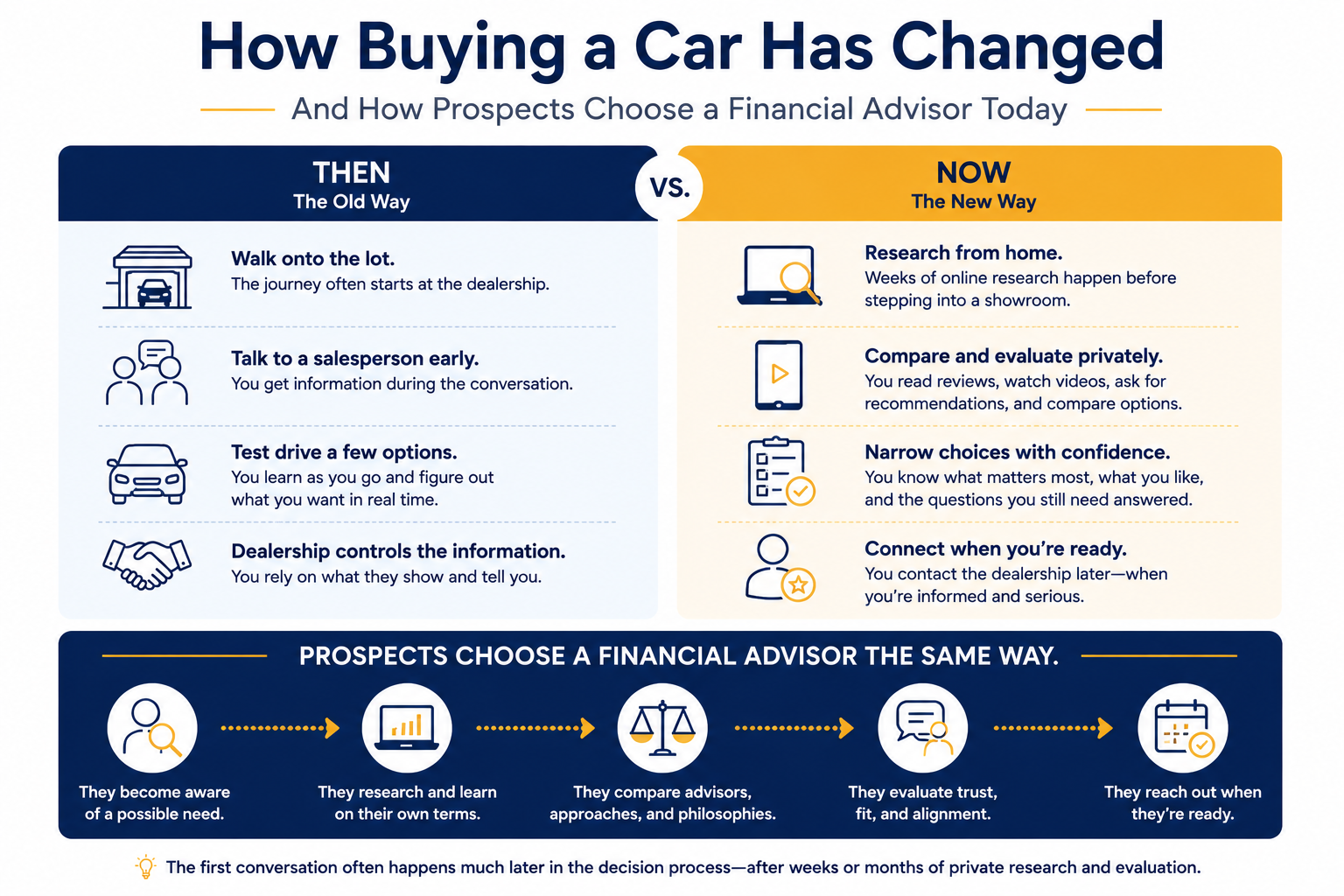
Years ago, the process often started at the dealership. You drove onto the lot, looked around, talked with a salesperson, maybe took a few test drives, and slowly figured out what you wanted in real time. The dealership controlled most of the information, so the conversation started early.
Today, most of the decision happens long before anyone visits a showroom.
People spend weeks researching online before they ever schedule a test drive. They compare models, read reviews, watch videos, ask friends for recommendations, calculate financing scenarios, and quietly narrow their choices from home. By the time they finally talk to a salesperson, they often already know which vehicles they are considering, what tradeoffs matter most to them, and which questions they still need answered.
The visible part of the buying process has become much shorter. The invisible part has become much longer.
The same thing is happening in financial advice.
Prospects are taking longer to say yes because far more of the decision now happens privately, during a hidden research phase that advisors rarely see directly. And that shift changes how marketing needs to work.
Key Takeaways
The Hidden Research Phase Is Longer Than Most Advisors Realize
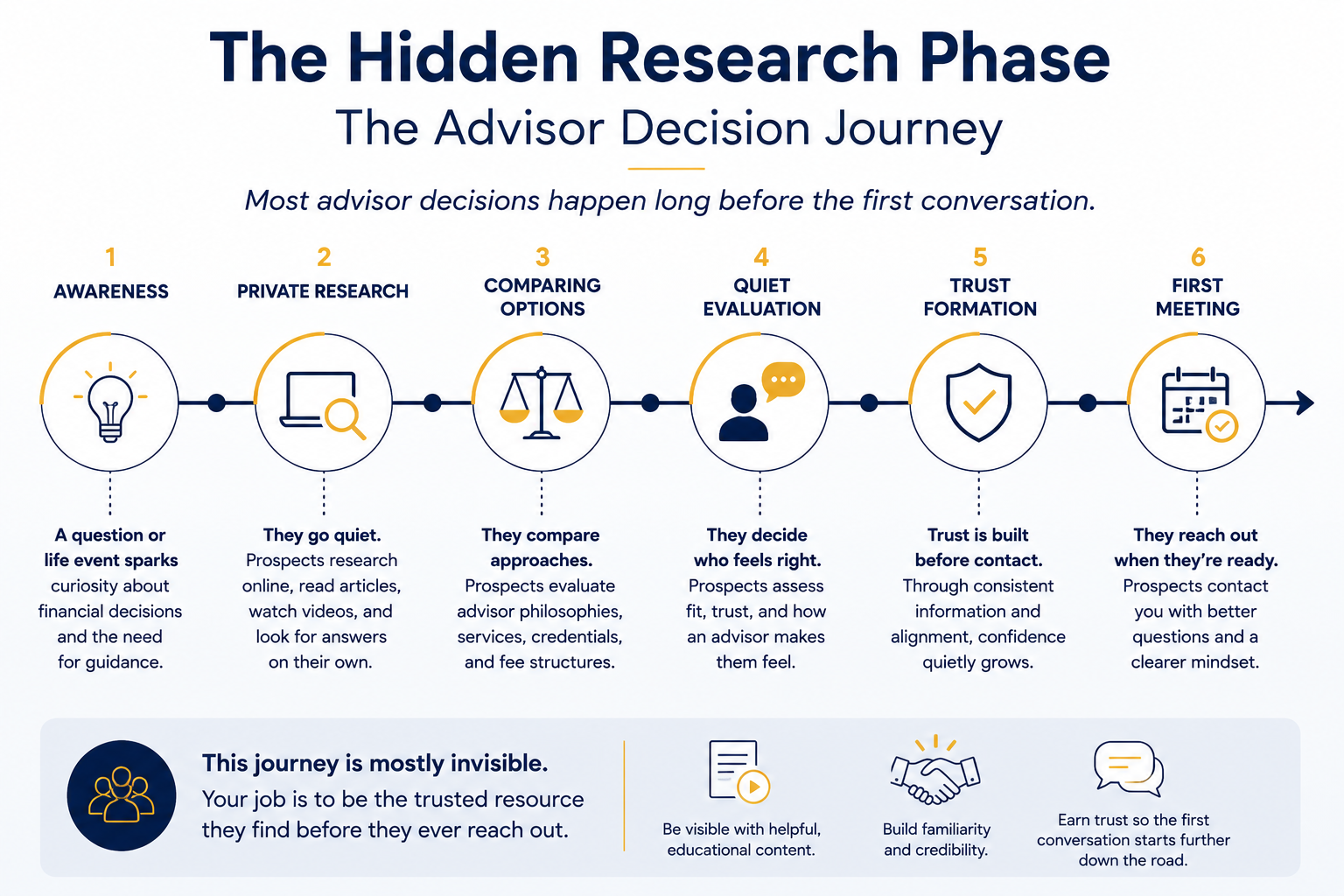
Many advisors interpret silence as disinterest. A prospect downloads a guide but never responds. Someone attends a webinar and waits months before booking a call. A referral says they are “thinking about it,” then disappears for a while. From the advisor’s perspective, it can feel like momentum stalled.
In reality, the prospect may still be actively moving forward. They are simply doing it privately.
Today’s buyers want time to orient themselves before engaging directly, especially when the decision involves something as personal and emotionally loaded as retirement, taxes, long-term planning, or protecting their family’s future. During that process, they are often comparing different advisory philosophies, reading articles, reviewing credentials, talking with spouses or family members, and trying to determine who feels trustworthy enough to invite into an important part of their life.
Much of this work happens outside an advisor’s visibility. You may never know which article they bookmarked, which webinar they revisited, or which conversation at the dinner table finally pushed them closer to reaching out. Yet all of those moments are shaping the decision.
That hidden research phase explains why many advisors feel like marketing results have become more unpredictable, even when they are consistently creating content, sending emails, or hosting events. The issue is not always visibility. Often, it is timing.
Most advisor marketing still assumes prospects are ready to engage much earlier than they actually are.

Why Traditional Marketing Starts Breaking Down
Traditional advisor marketing was largely built around a shorter decision cycle. The assumption was straightforward: generate attention, schedule a meeting, and move the prospect toward becoming a client.
That approach becomes less effective when prospects spend weeks or months researching independently before they are willing to talk.
Many firms unintentionally create friction because their messaging speaks almost exclusively to decision-ready buyers. Their websites, emails, and campaigns quickly push toward consultations, portfolio conversations, or discovery meetings, while many prospects are still trying to answer more foundational questions.
They are not yet asking, “Who should manage my money?”
They are still asking, “Who actually understands what I’m trying to solve?” or “Who can explain this in a way that makes me feel more confident?”
When marketing skips over that learning stage, prospects continue researching elsewhere. This is one reason so many advisors experience strong visibility without consistent conversion. Attention alone does not move someone forward if they still feel uncertain about the decisions in front of them.
Prospects don’t want more information. They want clarity they can trust.
What Education Does Differently
Education works differently because it supports the hidden research phase instead of trying to interrupt it.
Rather than pushing prospects toward immediate action, education gives them space to learn at their own pace while quietly evaluating the advisor behind the information. A workshop, webinar, article, or planning guide does more than transfer knowledge. It gives prospects a preview of what the relationship itself might feel like.
As they engage with educational content, prospects begin paying attention to subtler questions. Does this advisor explain complex ideas clearly? Do they sound grounded or reactive? Are they trying to teach or trying to close? Would I feel comfortable bringing my concerns to this person?
That process reduces uncertainty before the first meeting ever happens.
It also changes the tone of the relationship when prospects finally do reach out. Advisors who consistently teach often find that new inquiries arrive more prepared and more aligned. Prospects show up with better questions, a clearer understanding of the advisor’s philosophy, and less need for basic orientation. Instead of starting from zero, the first meeting feels like a continuation of a conversation already happening in the prospect’s mind.
That is one reason education-led marketing tends to produce stronger-fit inquiries over time.
The Car Buying Parallel Matters More Than It Seems
The shift in how people buy cars reflects a much broader behavioral change.
Today, most consumers do not want to be sold before they feel informed. Whether they are choosing a vehicle, hiring a contractor, or selecting a financial advisor, they want time to research, compare options, and build confidence privately before entering a conversation.
Financial advice is no different.
The advisors gaining traction right now are often the ones who recognize that prospects need support during this quieter evaluation phase. Instead of trying to force people through the funnel faster, they focus on staying useful while the prospect decides.
That usually means creating educational experiences that help people think more clearly about the decisions already in front of them. It means building trust gradually through useful content, workshops, webinars, and ongoing communication that reinforces consistency rather than urgency.
In many ways, marketing becomes less about persuasion and more about guidance.

What Advisors Should Focus on Instead
If prospects are taking longer to say yes, the answer is not necessarily to speed them up. The better response is to remain relevant and useful throughout the decision process.
That requires a shift in mindset. Marketing should not only aim to generate attention. It should help prospects understand important decisions, reduce confusion, and build confidence before a meeting ever takes place.
The firms that compound trust most effectively tend to be the ones that continue showing up consistently during the hidden research phase. They keep teaching. They keep clarifying. They keep helping prospects make sense of complicated financial questions without forcing urgency before someone is ready.
Over time, that consistency creates familiarity. And familiarity often becomes the bridge between quiet interest and meaningful action.
The first meeting often starts long before the calendar invite.
A Better Way to Support How Prospects Decide
FMT Solutions helps independent financial advisors build education-led marketing systems designed for today’s longer decision cycles.
Through the Financial Educators Network, advisors use workshops, courses, and structured educational campaigns to help prospects learn before the first meeting, so conversations begin with more trust, more context, and better alignment.