- Market volatility often increases attention to financial decisions, even when prospects delay immediate action.
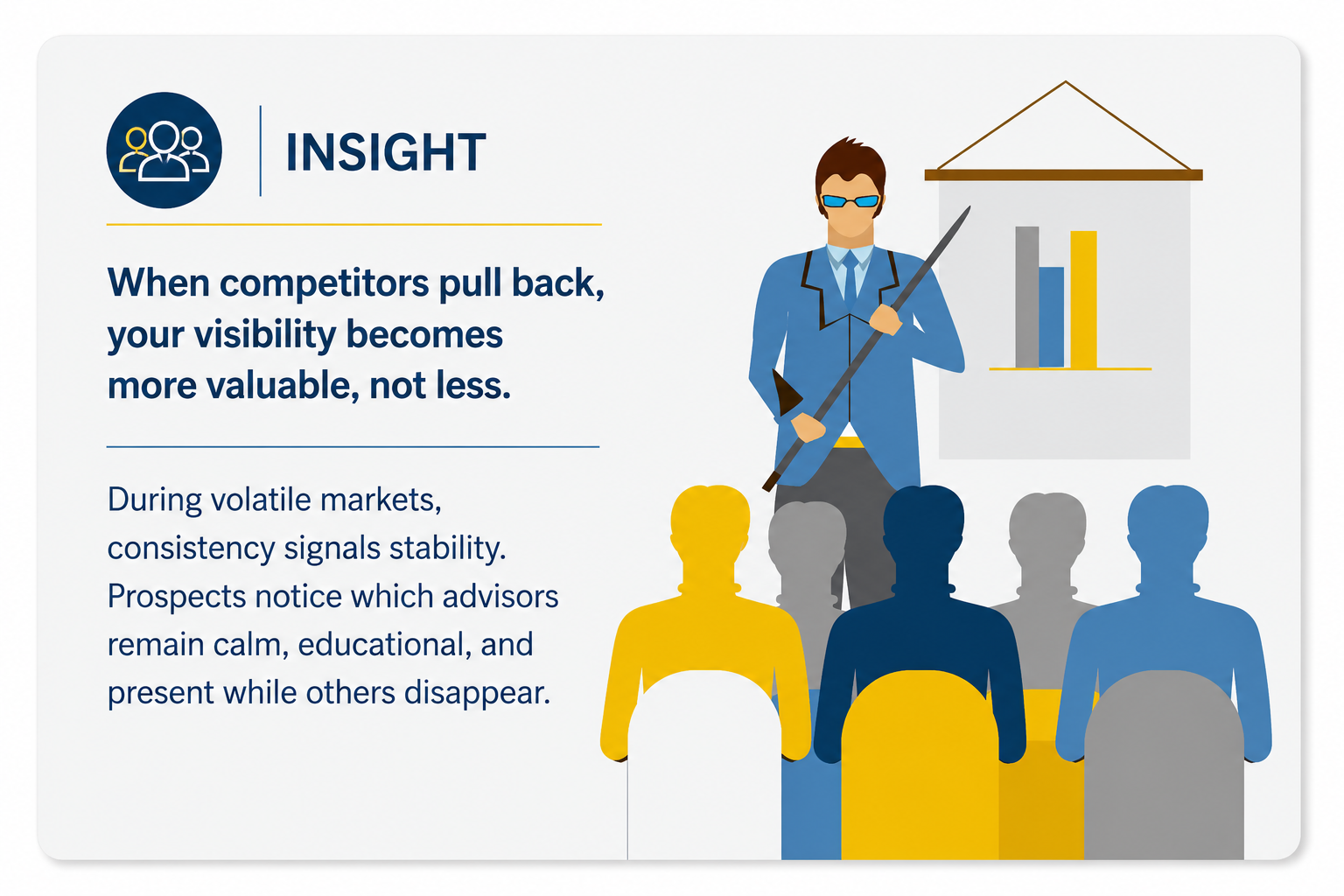
- Many firms reduce visibility during uncertainty, creating space for consistent advisors to stand out.
- Prospects evaluate tone, consistency, and judgment carefully during volatile periods.
- Education-based outreach helps advisors remain visible without sounding reactive or promotional.
- Trust compounds faster when advisors continue showing up calmly while competitors go quiet.
Why Market Volatility Is Actually a Growth Opportunity (If You Show Up the Right Way)
Periods of uncertainty change how people search for guidance. Advisors who stay visible, steady, and educational during volatile markets often build trust long before competitors re-engage.

Nick Schilling
CEO
Most advisors can feel the shift when markets become volatile. Conversations change. Clients start asking different questions. Prospects who had been casually thinking about retirement or long-term planning suddenly become more attentive to risk, income, taxes, and whether their current strategy can actually hold up under pressure.
At the same time, uncertainty creates a different kind of pressure inside advisory firms. Marketing begins to feel harder to justify. Outreach gets second-guessed. Educational events feel riskier to promote. Many firms quietly reduce visibility because they worry that continuing to market during uncertain periods could feel insensitive, overly promotional, or disconnected from what people are experiencing emotionally.
That instinct is understandable, but it often overlooks what is actually happening underneath the surface.
Periods of volatility rarely eliminate interest in financial guidance. In many cases, they intensify it. Prospects begin researching more carefully, revisiting assumptions they have not questioned in years, and paying closer attention to which advisors appear steady, thoughtful, and capable of helping them make sense of uncertainty without adding more noise.
The advisors who benefit most during these periods are usually not the ones making dramatic predictions or increasing pressure. They are the ones who continue showing up consistently, communicating calmly, and helping people think clearly while competitors retreat into silence.
That is what makes volatility a genuine growth opportunity for advisors who approach it the right way.
When markets feel uncertain, visibility becomes a signal of steadiness
Key Takeaways
Why Advisors Pull Back During Volatility
When markets become unpredictable, many advisory firms instinctively reduce their marketing activity because uncertainty creates pressure to avoid saying the wrong thing at the wrong time. Educational events get postponed, campaigns are delayed, communication cadence slows down, and advisors begin operating from a wait-and-see mindset while they try to determine whether prospects are still paying attention.
In some firms, this shift is driven by budget concerns. In others, it comes from discomfort around promoting services while clients and prospects are feeling anxious about headlines, account balances, or the broader economy. Even advisors who strongly believe in the value of financial planning can begin wondering whether visibility during uncertain periods might come across as opportunistic.
The challenge is that silence creates its own message.
When firms disappear during volatility, prospects lose visibility into how those advisors think and communicate when conditions become difficult. Momentum built through months of consistent outreach begins fading quietly in the background, even if the consequences do not show up immediately in pipeline reports or inbound activity.
At the same time, the firms that continue showing up calmly and consistently become easier to notice because consistency itself starts functioning as a trust signal. Prospects begin paying attention not only to expertise, but also to composure, communication style, and whether an advisor appears grounded when uncertainty rises.
This dynamic shows up repeatedly during uncertain markets. Advisors who maintain thoughtful communication while competitors retreat often strengthen trust faster because their visibility feels steady rather than reactive.
That does not mean increasing volume or turning market volatility into a promotional opportunity. It means remaining present, continuing to teach, and reinforcing clarity while many other firms become quieter.
This idea closely aligns with a principle explored in FMT’s guide, Marketing Without the Noise, which explains how firms that create steady growth during uncertainty are often the ones that avoid reactive pivots and continue reinforcing clarity while others scramble to adjust.
Volatility Changes Prospect Behavior, Not Interest
One of the biggest misconceptions about volatile markets is the assumption that prospects stop paying attention when uncertainty rises. In reality, many people become more focused on financial decisions during these periods because volatility forces long-delayed questions back to the surface.
People begin revisiting retirement assumptions, evaluating whether their current strategy is sustainable, and wondering how prepared they actually are for changing market conditions. Questions around taxes, income planning, healthcare costs, legacy goals, and long-term stability suddenly feel more immediate than they did during calmer periods.
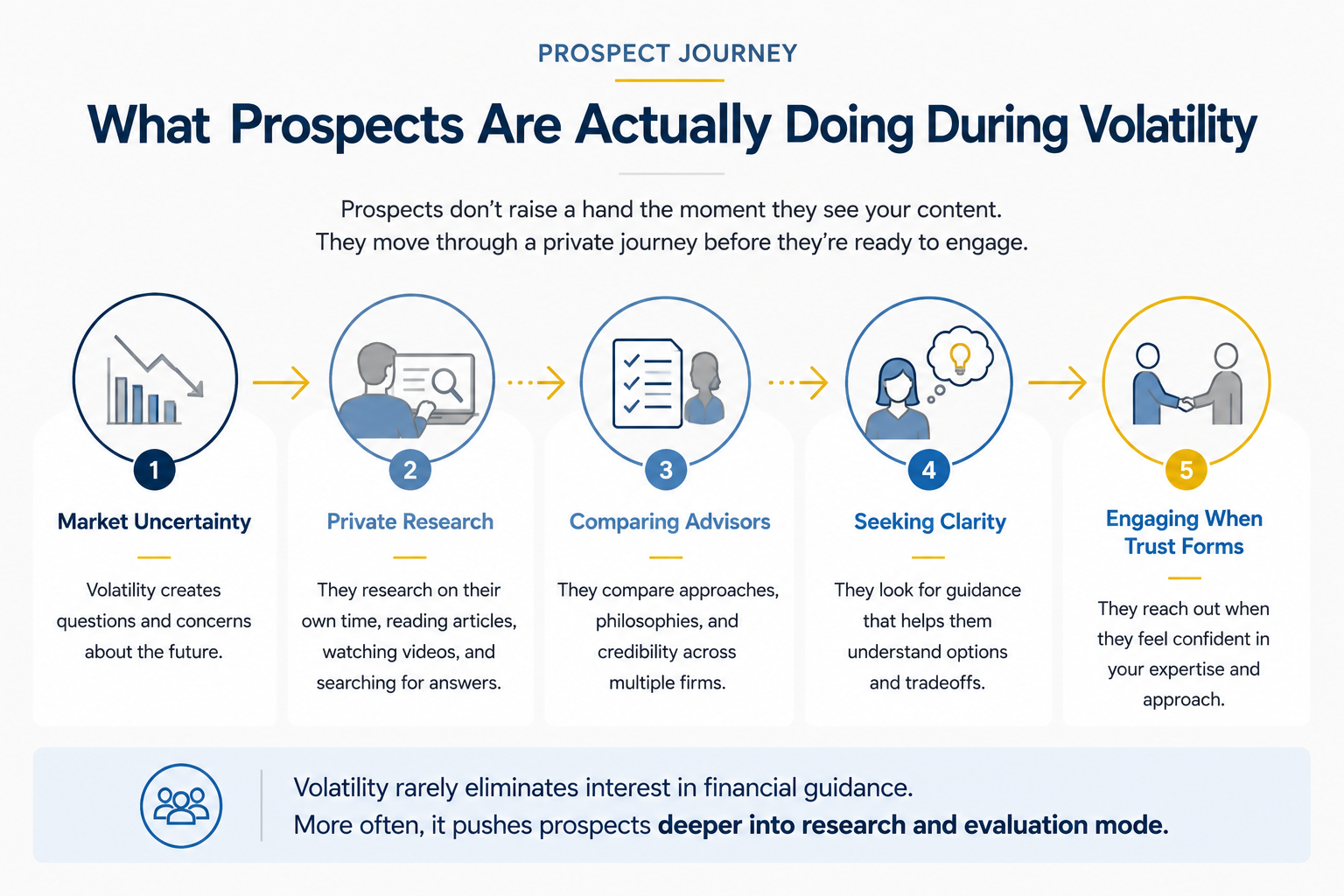
Most of this evaluation happens quietly.
Prospects spend more time researching online, comparing advisor approaches, revisiting websites, reading educational content, and trying to determine which firms feel trustworthy before they ever schedule a meeting. They may forward articles to a spouse, save workshop information for later, or return repeatedly to educational resources while they process decisions privately.
That distinction matters because volatility does not necessarily create an immediate “ready to hire an advisor” moment. More often, it creates a trust formation moment where people become increasingly attentive to how advisors communicate, explain tradeoffs, and respond to uncertainty.
Many firms misinterpret slower responsiveness as reduced interest, but prospects are often moving deeper into evaluation mode rather than disengaging entirely. They are trying to reduce emotional and financial risk before committing to a relationship, which means they pay closer attention to tone, consistency, and clarity than they might during more stable periods.
This behavior closely reflects patterns explored in FMT’s article, Why Most Advisor Marketing Fails, which explains how most individuals and families move through a long private research phase before they ever contact an advisor directly.
Volatility changes the emotional tone of decision-making. Advisors who continue teaching through uncertainty often become the voice prospects remember later.
Visibility Builds Trust During Uncertainty
Volatile markets create an unusual opening for advisors who remain visible in the right way because consistency becomes far more noticeable when many competitors reduce communication or disappear entirely.
During uncertain periods, prospects are not simply evaluating technical expertise. They are evaluating judgment, composure, communication style, and whether an advisor appears capable of helping them navigate complexity without adding unnecessary anxiety to the situation.
That is why visibility works differently during volatility than it does during calmer markets.
People are not necessarily looking for louder opinions or dramatic predictions. More often, they are looking for someone who can help them think clearly while emotions and headlines become more intense.
The advisors who build trust during these periods are rarely the ones pushing aggressive campaigns or trying to capitalize on fear. Instead, they continue teaching. They explain planning tradeoffs, host educational workshops, simplify complicated decisions, and reinforce long-term thinking when many people feel overwhelmed by short-term noise.
This type of visibility lowers emotional friction instead of amplifying it. Prospects begin associating the advisor with steadiness, clarity, and thoughtful guidance because the communication itself feels grounded and useful.
FMT has seen this pattern repeatedly through firms that maintain education-led outreach during uncertain markets. Advisors who continue offering workshops and structured educational experiences often strengthen long-term momentum because prospects remember who helped them think clearly when uncertainty was highest.
The opportunity is not about increasing noise or pushing harder for immediate action. It is about remaining present while others retreat.
Why Education Works Especially Well in Volatile Markets
Education changes the emotional experience of marketing because it gives prospects a way to engage with financial guidance without feeling pressured into immediate action. That difference becomes especially valuable during uncertain periods when people are already feeling overwhelmed by headlines, predictions, and conflicting opinions.
Volatility increases emotional friction. People hesitate more. They second-guess prior assumptions. They delay decisions because uncertainty makes the consequences feel larger and more personal.
Education helps reduce that friction by creating space for clarity.
Instead of asking prospects to commit immediately, educational experiences help them understand how decisions work, what tradeoffs exist, and which factors matter most over the long term. That process helps people regain a sense of orientation and control during periods that otherwise feel emotionally chaotic.
This is one reason classroom-based marketing performs differently than traditional promotional outreach during volatile markets. A workshop, webinar, or educational guide allows prospects to learn at their own pace while evaluating the advisor through the quality of the teaching experience itself.
Prospects begin paying attention to questions such as:
- Does this advisor explain decisions clearly?
- Do they acknowledge tradeoffs honestly?
- Does their guidance feel thoughtful or reactive?
- Do they simplify complexity without oversimplifying reality?
- Would I trust this person to guide me during difficult periods?
Those signals matter more during uncertainty because prospects are trying to reduce emotional risk before they commit to a relationship.
Education also supports the longer evaluation cycles that often emerge during volatile periods. Someone may attend a workshop, download a guide, or revisit a webinar weeks later after another market swing causes them to rethink their situation. That repeated engagement creates familiarity and trust over time.
This aligns closely with ideas explored in Trusted from the Start, where education is positioned not as a lead-generation tactic, but as a trust accelerator that allows prospects to experience an advisor’s reasoning before a one-on-one conversation ever begins.
What Smarter Advisors Do During Volatility
The advisors who navigate volatile markets most effectively tend to approach communication differently because they resist the temptation to either disappear entirely or react emotionally to every new headline.
Instead, they focus on reinforcing clarity, consistency, and long-term thinking while helping prospects and clients stay oriented around decisions that matter.
In practice, that often starts with maintaining a predictable communication cadence. Consistency becomes especially important during uncertain periods because prospects are paying closer attention to reliability and follow-through. Advisors who continue showing up steadily create reassurance simply through presence.
These firms also tend to teach more and predict less. Educational guidance usually performs better than dramatic market commentary because it reduces confusion instead of amplifying it. Rather than trying to forecast every short-term movement, they focus on helping people understand planning frameworks, tradeoffs, and long-term strategy.
The strongest advisors also avoid allowing volatility to completely disrupt educational momentum. Workshops, webinars, and planning-focused educational experiences continue running because these environments create structured opportunities for trust-building precisely when people are most actively looking for guidance.
Communication style often shifts as well. Smarter advisors simplify messaging during volatile periods because uncertainty already creates information overload. Prospects become more responsive to calm, practical explanations than to highly technical analysis or emotionally charged commentary.
None of these approaches require increasing urgency or pressure. In many ways, the opposite is true.
The firms that build the strongest momentum during uncertain periods often sound more measured, more patient, and more grounded than competitors who react impulsively to every market movement.
What Changes When Advisors Stay Visible
When advisors continue showing up thoughtfully during volatile periods, the quality of future conversations often changes.
Prospects arrive more prepared.
Trust forms earlier.
Meetings become less transactional.
Referral momentum strengthens because clients remember who stayed calm and communicative when uncertainty was highest.
The effects are not always immediate.
Often, they compound quietly over time.
Someone attends a workshop during market volatility but waits several months before scheduling a conversation.
Another prospect saves an educational guide and revisits it repeatedly before reaching out.
A client forwards a webinar recording to a friend who is struggling with retirement decisions.
These behaviors rarely show up inside vanity metrics, but they shape long-term growth.
This distinction mirrors an idea explored in FMT’s article, Vanity Metrics Are Lying to You, which explains why the strongest indicators of marketing momentum tend to show up in conversations and trust signals, not surface-level engagement.
The advisors prospects remember after volatility are usually the ones who stayed steady while everyone else reacted.
Build Trust Before Markets Calm Down
See how FMT Solutions helps advisors stay visible through education-led outreach that builds trust, supports long-term relationships, and keeps growth moving during uncertain markets.
Related Content

Teaching Freely, Staying Compliant
When the compliance work is already handled, advisors can teach like they mean it.
Article

The Person at the Front of the Room
Before an audience weighs your advice, they weigh you. A "why" story is how you give them a reason to trust.
Article

The First Five Minutes: Why Advisors Lose the Room Before They Start Teaching
The opening of an education-led event decides whether anyone learns from the rest of it.
Article