- A productive first meeting depends on what the prospect already understands before they arrive.
- Education helps reduce the “orientation tax” by giving prospects context, vocabulary, and confidence earlier in the journey.
- Informed prospects tend to ask more applied questions, which allows the conversation to move faster into their actual situation.
- Strong educational events build both comfort and credibility before the first one-on-one meeting.
- When education does its job, the first meeting becomes less about explaining the basics and more about applying the advisor’s guidance.
What Actually Makes a First Meeting Productive
How education helps prospects arrive with context, confidence, and better questions before the first conversation begins.

When advisors talk about a good first meeting, they usually describe it from their own side. The prospect seemed engaged. The conversation flowed. A follow-up got scheduled. Those are real signals, but they're symptoms. They don't explain what was different about this particular meeting, or what would need to be true for the next one to go the same way.
The more useful question is what the prospect brought into the room. A first meeting is productive because of what the prospect already understood, already trusted, and already wanted to talk about before they sat down, not because of anything the advisor did once the meeting started.
An event doesn’t just introduce a prospect to an advisor. Done well, it pre-pays the orientation tax.
Key Takeaways
The Orientation Tax
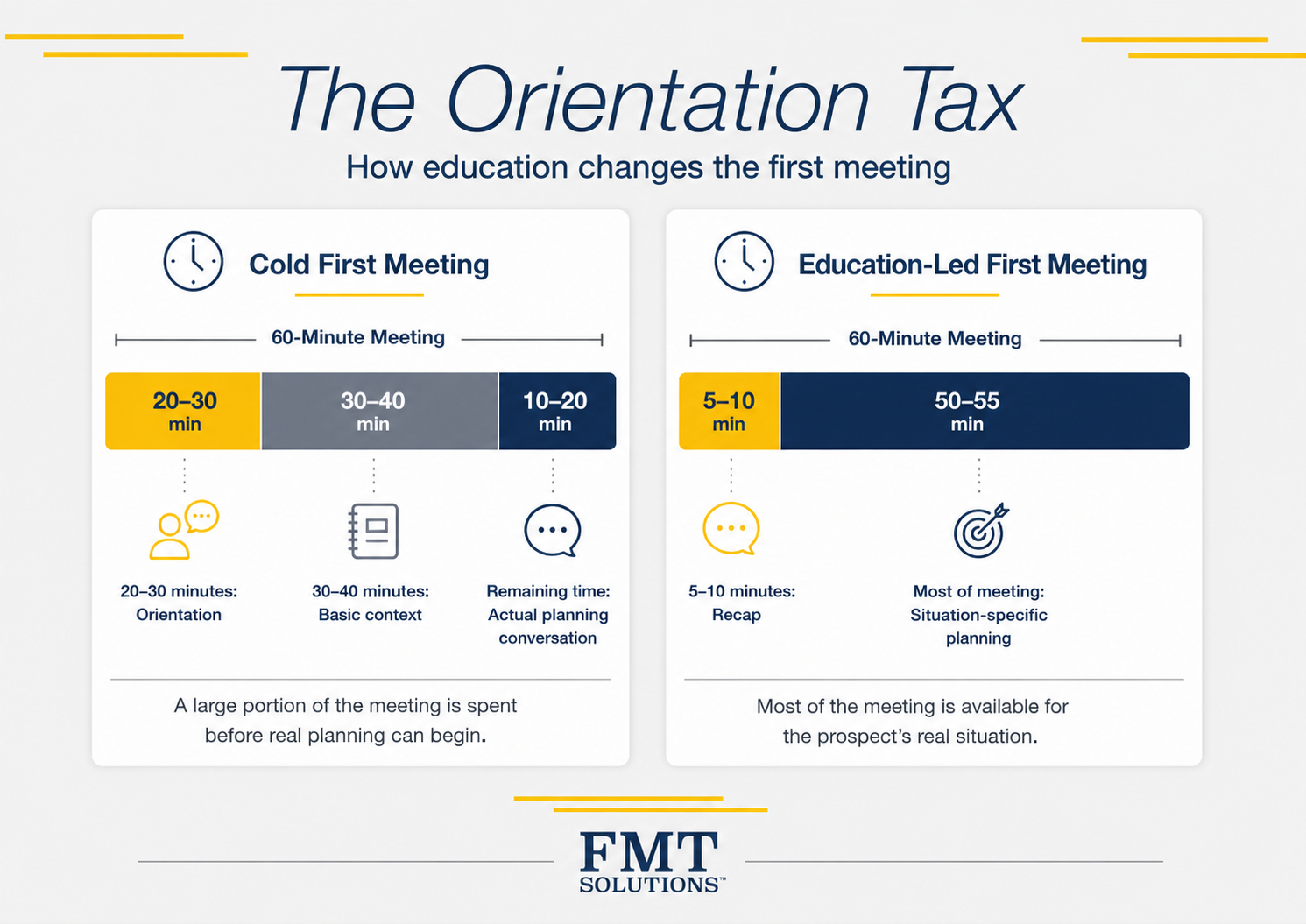
Picture a first meeting with someone coming in cold, no prior contact with the firm beyond an initial call to schedule. A meaningful chunk of that meeting goes to orientation: explaining what the firm does, how the advisor gets paid, what a fiduciary standard means, and laying out basic concepts the rest of the conversation depends on. None of that is wasted time. But it isn't planning either. It's the setup that has to be in place before planning can start.
If the meeting runs an hour and twenty or thirty minutes, go to orientation, and a third to half of the meeting passes before the conversation gets to the prospect's actual situation. That's the orientation tax, and it gets paid in every first meeting where the prospect arrives without context.
What an Informed Prospect Changes
An event doesn't just introduce a prospect to an advisor. Done well, it pre-pays the orientation tax for everyone who attends. By the time someone who went through an event sits down for a first meeting, they already have a working vocabulary for the topics being discussed, a sense of how the advisor thinks and approaches problems, and at least a partial answer to “can I trust this person” before the meeting starts.
“Education for sure is key,” said Lou Barberio, President and Senior Partner of Barberio Financial Services. “Getting these individuals into a classroom setting and educating them on all the aspects of planning for retirement makes the prospect feel comfortable, and it enables us to demonstrate that there's a lot that needs to get done, and that we're competent to help them do it. It's been an absolute game changer.”
Notice that this quote has two parts, and both matter. The prospect feels comfortable, and the advisor's competence has already been demonstrated. A first meeting that's missing either one still has work to do before it can become productive. Comfort without demonstrated competence leaves a prospect who likes the advisor but isn't sure they can handle the work. Competence without comfort leaves a prospect who's impressed but guarded. An event that delivers both walks a prospect into the first meeting, already past that stage.

What "Ready" Sounds Like
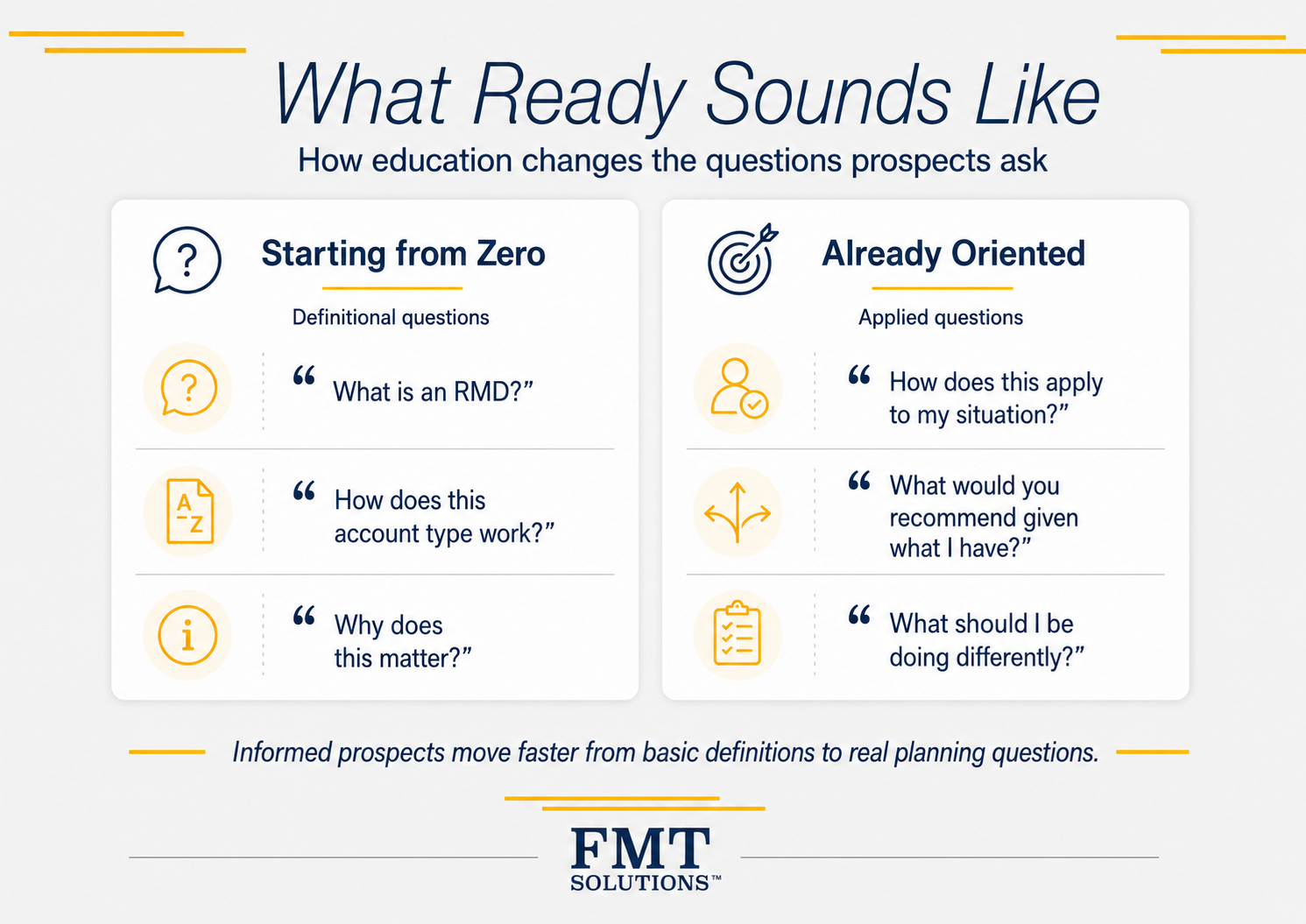
The difference between a prospect who arrives informed and one who doesn't shows up in the kinds of questions they ask. A prospect starting from zero tends to ask definitional questions: what is an RMD, how does this account type work, why does this matter. A prospect who's already been through an event tends to ask applied questions instead: how does this apply to my situation, what would you recommend given what I have, what should I be doing differently than I am now.
Eric Peterson, President of Peterson Financial Group, pointed to the same shift when he described what attending a multi-hour class signals about a prospect:
“When a potential client gives up several hours of their life to attend a class, and pays a fee to do it, you know they're going to be attentive,” he said.
Attentiveness during the event carries forward into the first meeting. A prospect who sat through several hours of material, asked questions, and engaged with the content arrives at the follow-up meeting already oriented toward the conversation the advisor actually wants to have. The meeting can start there instead of working up to it.

Building the Event With the First Meeting in Mind
This points to something worth checking in event planning: does the event cover the material that would otherwise eat into first-meeting time? An event built only around the most engaging or attention-grabbing topics, without the foundational concepts a planning conversation depends on, can still build comfort and credibility. But it leaves the orientation tax unpaid. The prospect likes the advisor and is willing to meet, and the first meeting still has to spend its first twenty minutes on the basics.
The fix isn't to make events less engaging. It's to treat the foundational material as part of what the event is for, woven into the stories and examples that make the event worth attending in the first place, rather than treated as separate from it. When that material lands during the event, the first meeting doesn't have to revisit it.
The Takeaway
A productive first meeting isn't a separate skill an advisor develops on top of everything else. It's a downstream result of what happened in the room before it. The trust that makes a prospect willing to meet, and the understanding that lets the meeting start with their situation rather than the basics, both come from the same place: an event that did its job. The first meeting is where that work gets cashed in.