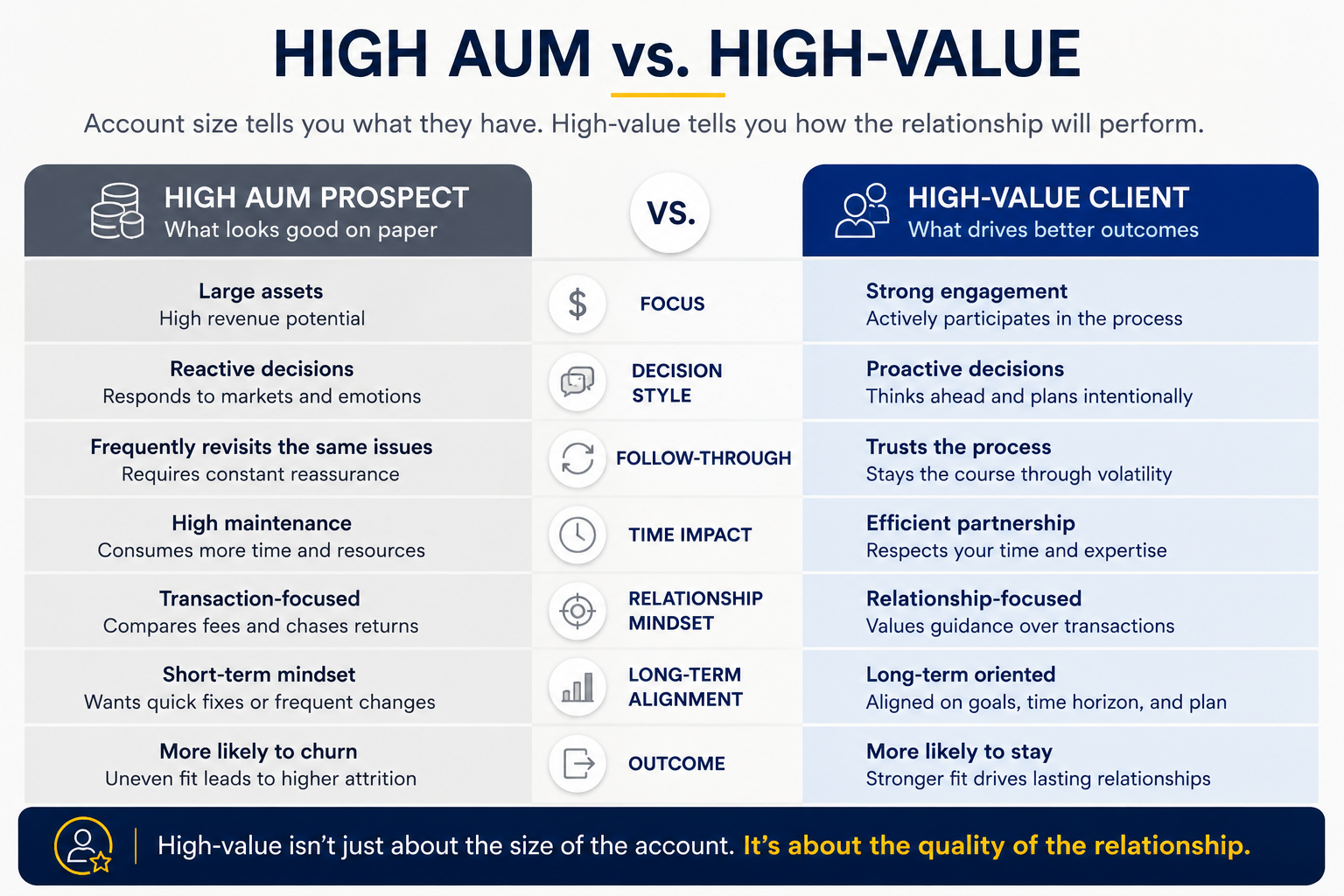
A More Complete Definition of High-Value
High-value relationships tend to share a common set of characteristics that extend beyond account size.
They often involve clients who are at a stage of life where guidance plays a central role. Transitions such as retirement planning, business exits, wealth transfer, or legacy decisions create natural openness to structured advice. Timing matters because it shapes motivation and focus.
High-value clients are also willing participants in an education-first process. They show curiosity about tradeoffs and ask questions that deepen understanding. Rather than outsourcing thinking, they engage with it. That engagement shortens decision cycles and leads to better alignment over time.
Fit plays a role as well. Advisors see their best outcomes when a prospect’s needs align with the services that they deliver best. When that alignment exists, conversations move forward with less friction, and the relationship compounds more naturally.
Taken together, high-value becomes a pattern of readiness, engagement, and alignment. Financial positioning remains part of the picture, but it works alongside these other signals rather than standing alone.
The Cost of Chasing the Wrong Signals
Many firms feel busy without feeling effective. Marketing calendars stay full. Lead volume appears steady. Yet few of those leads develop into strong client relationships.
This experience often traces back to how high-value is defined. Broad targeting pulls in interest from people who are curious but unprepared. Messaging that emphasizes scale or performance may attract attention without screening for fit. Teams spend time qualifying prospects who were never positioned to engage deeply.
Over time, the system reinforces itself. Advisors add more activity to compensate for low conversion, costs rise, and decision fatigue sets in. None of this reflects a lack of effort or discipline. It reflects a system built on signals that do not predict long-term value.
Moving From Intuition to Intentional Design
Most advisors already have a sense of which relationships work best. They can describe the clients who ask better questions, stay engaged, and benefit most from guidance. The challenge lies in translating that intuition into a repeatable system.
Intentional design starts with definition. When advisors take time to articulate what high-value looks like in practice, they gain a reference point for evaluating prospecting, messaging, and channel choices. That definition informs who to target, where to focus outreach, and how education can support self-selection before a direct conversation begins.
Education plays a central role here. Well-designed educational experiences allow prospects to demonstrate readiness through participation. They create space for learning and reflection before decisions are required. Advisors gain insight into engagement levels long before formal onboarding.
Sustaining a High-Value System Over Time
High-value client acquisition is not a one-time exercise. Markets, regulations, and client needs change over time, so firms that grow steadily revisit their definitions and adjust their systems accordingly.
They track which sources deliver strong-fit relationships and refine messaging to reflect real client behavior rather than assumed preferences. They also protect capacity by declining opportunities that fall outside their definition, even when those opportunities appear attractive in isolation.
A realistic view of “high-value,” supported by this kind of ongoing review, allows advisors to scale while preserving the quality of their relationships and the energy required to support them.