- Not every valuable attendee converts right away. Some event attendees may take months or years to act, but the event still begins the trust-building process.
- Educational events attract more committed prospects. When someone gives up several hours to attend a class, they are signaling attention, relevance, and a willingness to learn.
- Teaching builds trust faster than selling. Advisors who answer questions openly, share real stories, and lead with value create a stronger foundation for future conversations.
- “Not yet” is different from “no.” Quiet attendees can become high-quality inbound leads later because they already know the advisor’s approach and credibility.
- Consistency turns events into a system. Advisors who run events regularly build a reservoir of past attendees, improve their delivery over time, and create a more durable acquisition engine.
- Follow-up keeps the relationship alive. Newsletters, relevant content, and thoughtful check-ins help maintain the connection until attendees are ready to move forward.
Why Today’s Event Attendees Are Tomorrow’s Ready-to-Act Clients
Eric Peterson, President of Peterson Financial Group, talks about what actually happens after an event ends

Nick Schilling
CEO
Most advisors walk out of a successful event focused on the people who raised their hand. The ones who booked a follow-up meeting, handed back a response card, or came up afterward to ask a question. Those are the names that make it into the CRM, and everything that happens next gets built around them.
The attendees who didn’t respond often get written off: the ones who listened for hours, asked a few questions, maybe took some notes, and headed home without scheduling anything. Not prospects yet. Maybe not ever.
It’s a narrow way to read what just happened.
Key Takeaways
FMT CEO Nick Schilling sat down with Eric Peterson, President of Peterson Financial Group and a Financial Educators Network instructor for more than ten years, to talk about what actually happens after an event ends. The conversation kept coming back to one idea: the people who don’t convert right away aren’t gone. They’re just not ready yet.
Peterson sees those quiet attendees differently. They are not lost leads. They are leads on a longer timeline, and the event already did the hard work of introducing them to the advisor, demonstrating competence, and building a foundation of trust that a cold outreach call never could.
The question isn’t whether they converted. It’s whether the advisor built something that earns the call when they’re ready.
What a Committed Prospect Looks Like
When someone gives up several hours of their time to attend an educational event, and in many cases pays to be there, they’re telling you something. Peterson described what that signal means for the quality of the people in the room.
“When a potential client gives up several hours of their life to attend a class, and pays a fee to do it, you know they’re going to be attentive.”
That attentiveness is worth examining. A prospect who chose to spend a meaningful block of time learning about financial planning is self-selecting in a way that cold outreach can’t replicate. They showed up because something in their life made the topic relevant. They paid attention because they had a reason to. That’s a different starting point than someone who clicked an ad or responded to a mailer.
There’s also an efficiency built into the event format that’s easy to miss. A room of thirty attendees isn’t just thirty individual prospects sitting in the same space. Every person is getting exposed to the same concepts, the same stories, the same sense of how the advisor thinks and approaches problems. By the time any of them sits down for a first meeting, the foundational work is already done.
“An education-led event doesn’t just introduce a prospect to an advisor. Done well, it compresses months of relationship-building into a single session."
The goal isn’t to fill a room and then close it. It’s to create an experience that does real trust-building work at scale, then let the relationship develop on its own timeline.
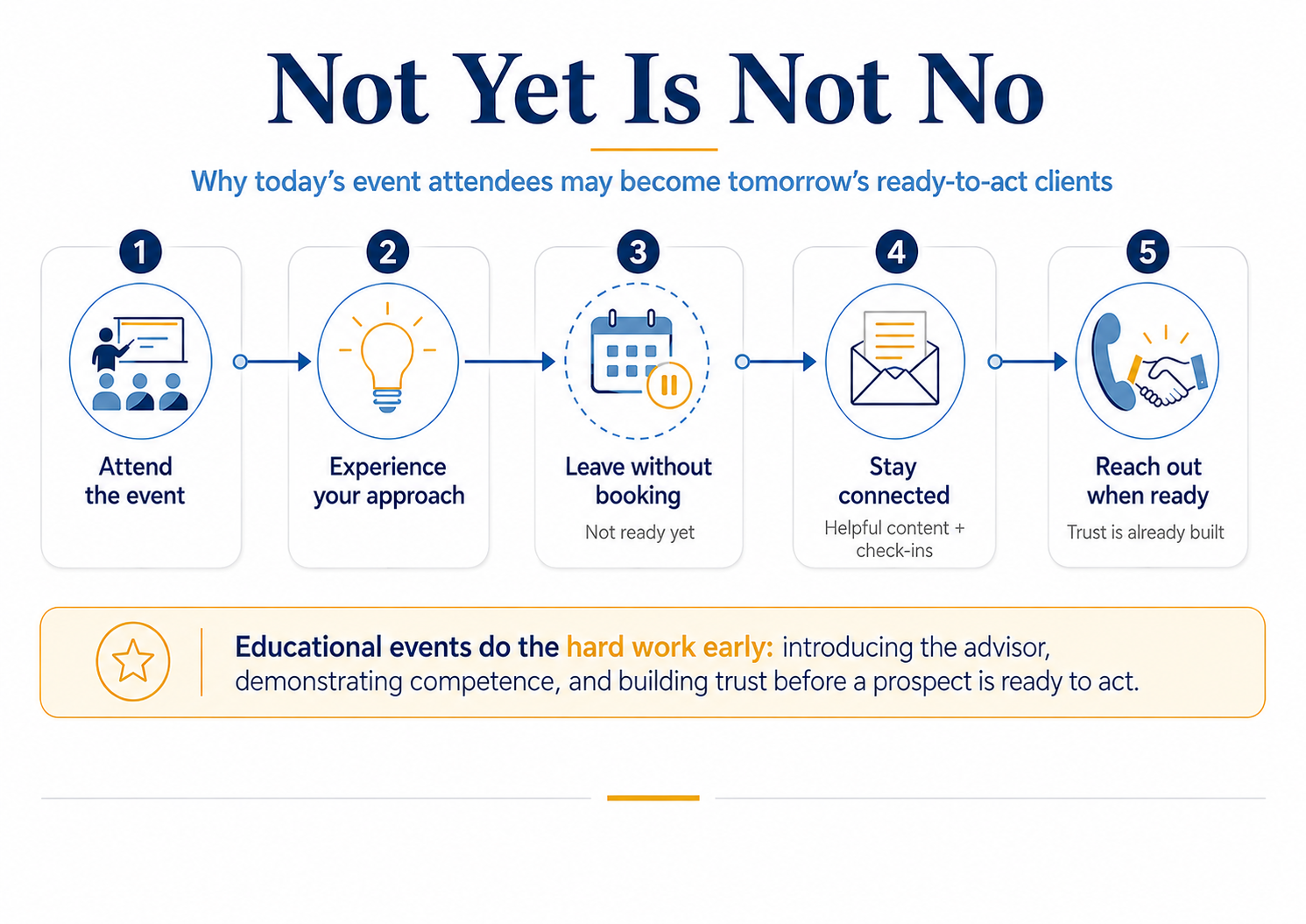
The Long Game: Why “Not Yet” Is Not the Same as “No”
The instinct to measure an event by immediate appointment conversions is understandable. Something happened, people showed up, and money was spent. What came out the other end? But that framing treats education-led events as direct-response marketing, where returns show up within days. The model doesn’t fit.
Peterson treats attendees who don’t convert immediately not as leads that didn’t work, but as seeds that haven’t germinated yet.
“You have to treat the classes akin to farming seeds. It may take a long time before they’re harvestable, but when they’re harvestable, it’s so easy. Someone calls and says, ‘Hey, I met with you a couple of years ago at one of your classes, and I’m ready to move that relationship forward.’”
Two years later, someone calls unprompted. That phone call is qualitatively different from almost any other inbound contact an advisor receives. The person calling already knows whom they’re calling. They remember attending an event and watching someone explain complex financial concepts in a way that felt clear and trustworthy. They’ve had time to think. They’re not shopping around. They’ve already made a decision; they’re just executing it.
Compare that to a lead from a digital ad or a purchased list. That person might be willing to have a conversation, but they don’t know the advisor, haven’t experienced their approach, and have no particular reason to choose them over anyone else. Every one of those leads requires starting from the beginning.
The event attendee who calls two years later is already past the beginning. The event handled the introduction, the credibility demonstration, and the early stages of trust. The advisor’s job at that point is to pick up the conversation where it left off.
A cold lead requires the advisor to earn trust from scratch. An event attendee already started that process, even if they weren’t ready to act when they left.
Consistency is what makes this compound. An advisor who runs events regularly doesn’t just have a pipeline of current leads. They have a reservoir of past attendees at various stages of readiness. Some are close. Some are years away. Some will never move forward. But the ones who do reach out are already pre-qualified in a way that cold acquisition can’t replicate, because the qualification happened at the event itself.
Keeping that reservoir alive requires more than running the events. A newsletter, an occasional check-in, and content relevant to the topics covered. Something that keeps the advisor present without being pushy. The event plants the seed. The follow-up keeps it from going dry.
Teaching as a Trust Strategy
Peterson’s approach reflects a philosophy that runs counter to how most advisors think about events. The instinct in a marketing context is to hold something back. Give enough to be helpful, but not so much that the prospect no longer needs to schedule a follow-up. Create a question you can answer in the meeting. Leave a hook.
Peterson does the opposite.
“I like helping people, and I carry that same mentality into financial services. I’m here to help people, even when sometimes we don’t make a dime off it. I want to help empower people to make the best decisions they can.”
Teach first, trust that the relationship will follow. That’s the orientation, and it shows up in how he runs an event.
He encourages instructors to be genuine in the room. Be the person people want to have a conversation with, not the one with the most expertise. The dynamic shifts when attendees feel like they’re talking to someone rather than being presented to. That informality lowers the guard most people bring into any interaction they sense is a sales context.
He uses real stories, not hypotheticals. There’s a difference between a generic case study and a story drawn from an actual client’s experience. Attendees can feel that difference. A real story signals that the advisor has actually done this work with real people who had real problems. It’s evidence, not illustration.
He asks questions and keeps the room engaged. An event that asks nothing of its attendees is a presentation. One that invites participation becomes a conversation. People who’ve contributed something, an answer, a question, a comment, are more invested in what happens next than people who sat passively through the same material.
And he gives away the answer. When someone in the room asks a specific, useful question, Peterson doesn’t redirect to a follow-up meeting. He answers it. Completely.
Holding back information to create a sales hook works against you. Generosity in the room is what earns the relationship outside of it.
The trust economics of giving information away are the opposite of what they appear to be. An advisor who withholds answers to create dependency signals that their relationship with clients is transactional. An advisor who answers questions openly signals the opposite: that they lead with value and trust that the relationship will follow.
The prospect in the room notices. Not always consciously, but the contrast is felt. That sense of “this person actually helped me, without asking for anything in return” is precisely what makes the call two years later feel so natural. The relationship has already started. The call is just the next chapter.
Building the System, Not Just Running the Events
Peterson’s sharpest observation isn’t about what happens at a single event. It’s about what happens across events, over time.
Most advisors who try education-led marketing run a few events, measure the immediate conversions, and draw conclusions. If the numbers look good, they keep going. If they don’t, they move on. What they miss is that the value of a repeatable event program compounds in ways that a single data point can’t capture.
- The advisor gets better. Every event is a chance to refine the material, test different stories, and figure out which explanations land and which ones lose the room. The advisors who build real skill are the ones who keep showing up and treat each session as a chance to improve, not a task to complete.
- The pipeline gets richer. Each event adds a new cohort of attendees to the reservoir. Some will convert in a week. Some in three years. A practice that has run consistent events for a decade has years of past attendees at every stage of readiness, and the inbound calls from that group are among the highest-quality leads the practice will ever see.
- The follow-up gets sharper.An advisor who reviews what worked after each event and adjusts their approach accordingly builds a system that improves with each iteration. The script for reaching out gets refined. The timing gets dialed in. The offer gets clearer.
None of this comes from running one event or ten. It comes from committing to the model long enough that the compounding effects become visible. Running events as a tactic looks different from building education as a system.
The Takeaway
An event that produces immediate appointments is a good event. But measuring every event only by what it closes in the first week misses most of what education-led acquisition builds over time.
The attendee who didn’t sign up was still in the room. They heard the material, experienced the advisor, and formed early impressions. They just aren’t ready yet, and “not ready yet” is a timeline, not a verdict.
The advisors who understand this build differently. They run events consistently, follow up thoughtfully, and treat each one as a point of contact in a relationship that might not move for months or years. When it does, the lead that arrives is already informed, already trusting, and already past the hardest part of the conversation.
The event planted something. The system kept it alive. And at some point, the phone rings.
See How Education-Led Marketing Works
Learn how advisors use FINRA-reviewed courses and repeatable campaigns to attract better-qualified prospects.
Related Content

Teaching Freely, Staying Compliant
When the compliance work is already handled, advisors can teach like they mean it.
Article

The Person at the Front of the Room
Before an audience weighs your advice, they weigh you. A "why" story is how you give them a reason to trust.
Article

The First Five Minutes: Why Advisors Lose the Room Before They Start Teaching
The opening of an education-led event decides whether anyone learns from the rest of it.
Article