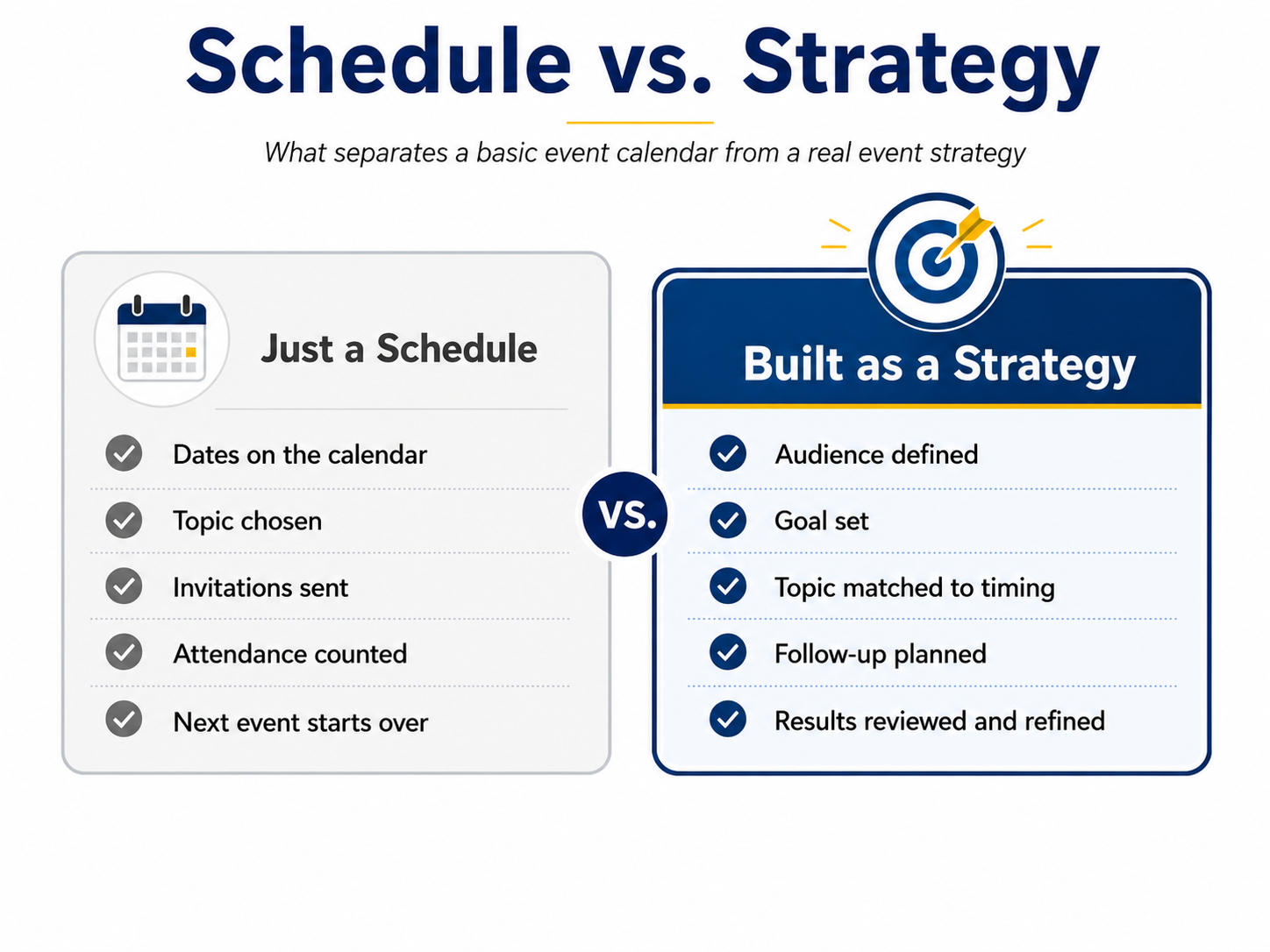
- A schedule tells you when something happens, but a strategy defines who it is for, what it should accomplish, and how it supports growth.
- The more clearly the audience is defined, the easier it becomes to shape content, promotion, and follow-up around what they actually need.
- An event designed to book appointments should look different from one designed to deepen client relationships or introduce the firm to a cold audience.
- Booking meetings at the event, assigning a follow-up owner, and tagging attendees in the CRM helps prevent value from leaking away afterward.
- Tracking RSVP rate, show rate, appointment rate, conversion rate, and post-event learnings turns each event into part of a repeatable growth system.
Your Event Calendar Needs a Strategy, Not Just a Schedule
A smarter event calendar connects each date to a defined audience, clear goal, intentional follow-up plan, and a review process that helps every event improve the next one.
A calendar full of events looks like a plan. There's a date in March, another in May, maybe a recurring monthly slot. It feels organized. But a schedule only answers one question: when. A strategy answers several more: who the event is for, what it needs to accomplish, how people find out about it, what happens to everyone in the room after it ends, and what gets adjusted before the next one runs.
Without those answers, every event gets judged the same way, in isolation. Did people show up? Did it feel like it went well? Those questions get asked fresh each time, with no thread connecting one event to the next. Building a real strategy means defining each of those pieces on purpose, before the date ever goes on the calendar. Here's what that looks like.
A full event calendar can look like momentum, but without a strategy, each event starts from zero instead of building on what the last one taught.
Key Takeaways
Start With a Defined Audience, Not "Anyone Interested"
Most invite lists are broad: everyone in the database, or anyone in the area near retirement age. That breadth dilutes everything downstream. The content has to stay general enough to apply to everyone in the room, attendees end up at wildly different stages of planning, and the follow-up offer that makes sense for one person doesn't make sense for the rest.
A defined audience narrows this. A few examples: people within two or three years of a specific retirement age, people who recently inherited an IRA, business owners thinking about an exit, widows and widowers navigating a recent loss, or current clients' adult children who haven't started planning yet. Each of these groups shares a specific situation, which means the content can speak directly to it and the follow-up offer makes sense for nearly everyone in the room, not just a few people.
That audience can come from several places: CRM segmentation by asset level, account type, or flagged life event; referral partners who can point to clients in a specific situation; or local information, like a nearby employer offering buyouts to a particular group of employees. The audience comes first. Once it's defined, almost every other decision about the event gets easier.

Set a Goal Before You Plan the Content
Many events get planned backward: pick a date, pick a topic, then figure out who to invite. A strategy starts with the outcome. What does this specific event need to produce? More first-time prospects for a younger audience? Follow-up meetings booked on the spot for an audience close to retirement? Stronger relationships with current clients who might refer someone they know?
The goal shapes everything that follows. An event built to generate appointments needs built-in moments for booking, scheduling cards on the tables, a clear next step at the end, and staff ready to set a time before anyone leaves the room. An event built to deepen relationships with current clients might prioritize informal time and open discussion over a packed agenda. An event built to introduce the firm to a cold audience might lean more on credibility and story, with less time spent on technical detail.
A stated goal also gives a way to judge the event afterward that goes beyond a general sense of how it felt. Without one, it's tempting to call every event a success because the room was full and the questions were good, even when none of that translated into anything measurable.
A strategy starts with the outcome, not the date.
Choose Topics That Match Real Planning Moments
A topic works best when the audience is already wondering about it. Tying topics to the calendar and to life events gives the room a reason to be curious before the event starts:
- Early in the year: tax-efficient withdrawal strategies, Roth conversion deadlines
- For an audience approaching 73: required minimum distribution planning
- During market volatility: sequence-of-returns risk for people retiring soon
- For recent widows or widowers: navigating finances after a loss, survivor benefits
- For business owners: what happens to the business at retirement, exit planning basics
- RSVP rate: invitations sent versus people who respond
- Show rate: RSVPs versus people who actually attend
- Appointment rate: attendees versus follow-up meetings booked
- Conversion rate: follow-up meetings versus new clients or accounts opened
A generic “retirement planning basics” session might be useful information, but it doesn't connect to anything the audience is actively thinking about right now. A topic tied to a real planning moment does, and that connection is often the difference between an audience that's politely listening and one that's actually engaged.
Plan the Follow-Up Before the Event Happens
The follow-up plan is the part most likely to get improvised after the fact, and improvising it is what causes most of the value of an event to leak away. A strategy decides this in advance: what the next step looks like, how it's offered, and what happens for people who don't take it right away.
Where it's possible, the strongest version of this is booking appointments at the event itself, with a sign-up sheet, a scheduler at the back of the room, or staff available to set a time before people leave. For everyone who doesn't book on the spot, the plan needs a defined timeline (such as outreach within 48 hours), a defined owner (who's making the call), and a defined offer (a complimentary portfolio review, a follow-up packet, or a specific next-step conversation).
Tagging each attendee in the CRM by which event they came from makes it possible to track what happens to them over time, not just whether they booked a meeting in the first week, but whether they became a client months later.
Decide How People Will Hear About It
The promotion channel and the audience need to match. Direct mail tends to work well for a geographically defined, often older audience. Email works for an existing list that's already engaged. Referral partners often produce the highest-quality leads, since the introduction comes with built-in trust. Paid digital ads can reach more people but with less precision about who actually shows up. And for an audience like “current clients' adult children,” the most effective channel might simply be the advisor asking the client directly to bring them, no ad spend required.
Choosing the channel after the audience is defined, rather than running the same promotion for every event regardless of who it's meant for, is one of the simplest ways to improve who actually walks into the room.
Track the Numbers That Actually Tell You Something
A strategy needs a way to measure whether it's working, and attendance alone doesn't answer that. A few numbers, tracked across every event, start to tell a real story:
On their own, these numbers from a single event don't mean much. Tracked over several events, they show whether a change, a new topic, a different format, a revised follow-up script, actually moved the needle, instead of relying on a guess about whether the last event "felt" better than the one before it.
Build a Review Into Every Cycle
After each event, a short debrief captures what worked, what didn't, and what should change next time, while it's still fresh. What questions came up that the content didn't address? Where did energy in the room pick up or drop off? Did the follow-up plan get executed the way it was designed, and did it produce the results the goal called for?
This step is the one most practices skip, usually because the next event is already approaching and there's no time built in to look back. But it's also the step that turns a series of events into something that compounds. Without it, each event starts over from scratch. With it, each event starts from what the last one taught.

The calendar stops being a list of dates when each event starts from what the last one taught.
Put It on the Calendar as a Cycle, Not a List
Once the audience, goal, topic, follow-up plan, promotion plan, and review are all defined for an event, the calendar stops being a list of dates and becomes the execution layer for a system. Four events on a calendar can mean four unrelated dinners, each one starting from zero, or four iterations of the same system, each one informed by what the last one revealed.
The dates themselves don't change. What changes is everything that happens around them, and that's what determines whether a calendar full of events adds up to a growth strategy or just a recurring task.